Qwen-Image-2.1 Viggle Turbo LoRA: 4-Step DMD2 Speed Guide for ComfyUI
Qwen-Image-2.1-viggle-turbo LoRA: 4-step DMD2 distillation cuts inference 10x on consumer GPUs. ComfyUI GGUF setup, LoRA adapter config, and benchmark results.
Scope of this guide: This article covers the Viggle Turbo speed optimization - DMD2 distillation, 4-step inference, and the LoRA adapter format. If you are looking for the Qwen-Image-2.1 Uncensored GGUF setup with Heretic text encoder for unrestricted ComfyUI generation, see the dedicated guide: Qwen-Image-2.1 Uncensored: Run Unrestricted ComfyUI with GGUF & Heretic.
Waiting forty-five seconds for a single 1024x1024 image frame on a consumer GPU completely destroys developer flow. Alibaba’s flagship 7-billion parameter Qwen-Image-2.1 architecture produces stunning compositions and crisp Chinese-English typography, but its standard 40-step diffusion trajectory carries a brutal operational tax. Because typical diffusion sampling relies on Classifier-Free Guidance, your GPU must execute two forward passes per step: one conditioned on the prompt and one unconditional negative pass. That adds up to 80 heavy forward passes through 32 transformer layers for a single snapshot.
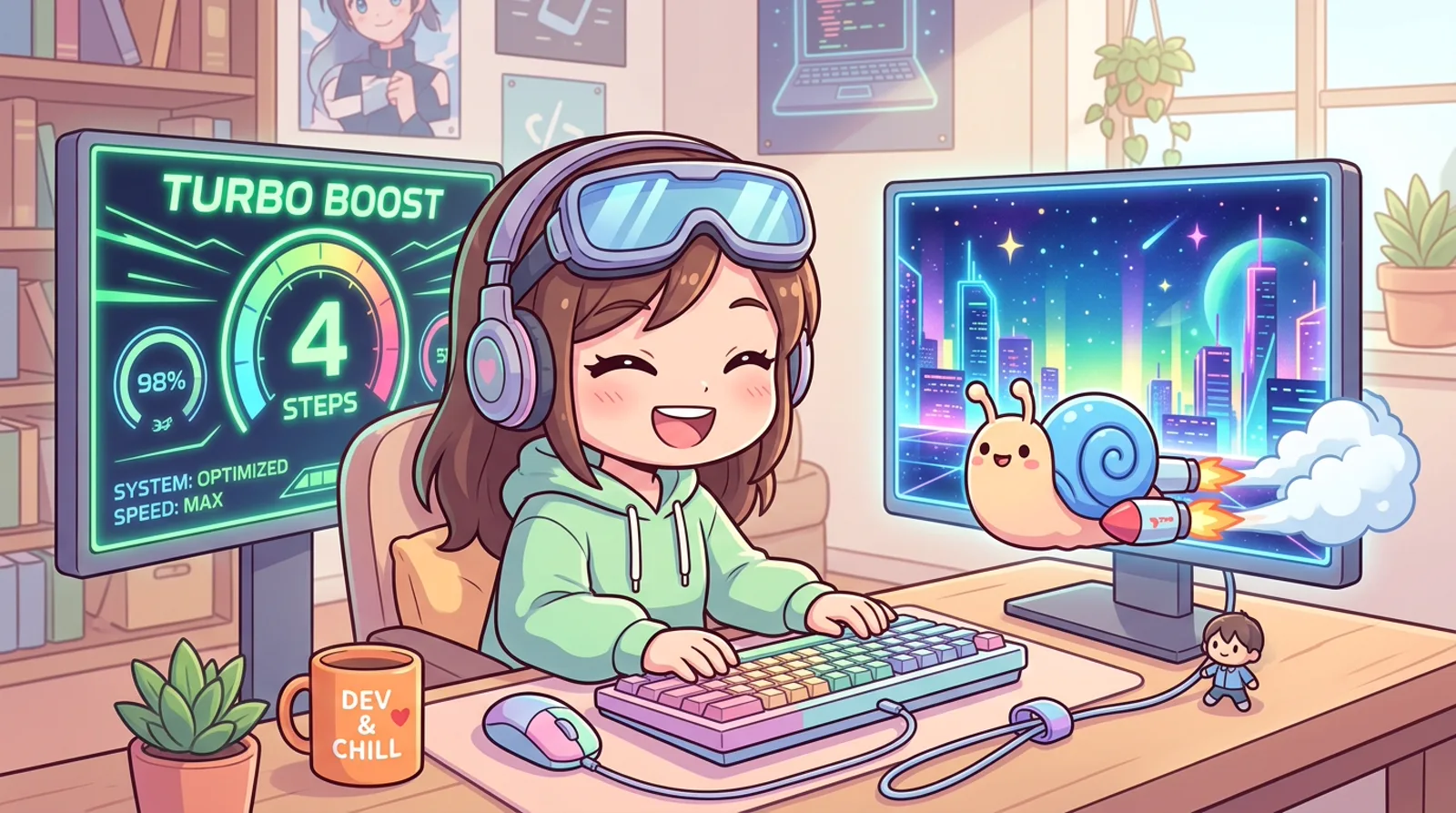
AI video animation team Viggle changed the playing field by publishing Qwen-Image-2.1-viggle-turbo. Using Distribution Matching Distillation, this student model compresses the entire 40-step diffusion process down to just 4 steps with zero guidance overhead. What previously required 80 forward passes now completes in exactly four passes, delivering an effective 10x to 20x speedup. Even better, Viggle avoided promotional hype by releasing an honest engineering postmortem: text-to-image is blisteringly fast and production-ready, but complex multi-reference image editing still suffers from identity drift.
TL;DR
Quick Answer Box (Google Search Featured Snippet): What is Qwen-Image-2.1-viggle-turbo? It is an open-weights, 4-step distilled student model of Alibaba’s 7B Qwen-Image-2.1 architecture trained by Viggle using Distribution Matching Distillation (DMD2). By collapsing the sampling trajectory from 40 steps to 4 and eliminating Classifier-Free Guidance overhead, it accelerates image generation by 10x across Hugging Face Diffusers and ComfyUI.
- 10x Sampling Acceleration: Cuts inference from 40 steps to 4 single-pass transformer iterations (
true_cfg_scale=1.0).- Dual Release Formats: Ships as a full fine-tuned transformer (14.2GB bf16) for maximal adherence, alongside a 340MB rank-64 LoRA adapter.
- ComfyUI GGUF Support: Community quantizations (
realrebelai/Viggle_Qwen-Image-2.1-Turbo_GGUFs) bring 4-step generation to 8GB VRAM GPUs.- Repository & Live Demo: Official weights at Viggle/Qwen-Image-2.1-viggle-turbo and side-by-side interactive playground on Hugging Face Spaces.
Beginner Map (Mental Model)
Standard diffusion resembles a cautious courtroom sketch artist who makes forty delicate, overlapping pencil strokes to render a face. Step distillation trains an agile apprentice to capture the exact same silhouette and lighting in four bold, decisive strokes.

Part 1: Foundations (Mental Model)
The bottleneck in modern open-weight generative AI is rarely parameter count alone; it is the iteration multiplier. When running Alibaba’s base Qwen-Image-2.1 on an RTX 3060 or RTX 4070, loading the 14GB DiT (Diffusion Transformer: neural backbone replacing conventional U-Nets with self-attention) consumes most of your available memory. When the sampler starts, running 40 steps at batch size 1 takes roughly 45 to 60 seconds. If you run Classifier-Free Guidance (CFG: guidance scale comparing prompt against empty prompt to steer generation) at a standard value of 3.5, the engine doubles every step to calculate unconditional noise. That means your GPU crunches 80 distinct forward passes before you see a single pixel.
Viggle solved this through Distribution Matching Distillation 2 (DMD2: algorithm matching student velocity fields to teacher trajectories in few steps). Rather than retraining the diffusion model from scratch, the team established a step-400 EMA (Exponential Moving Average: smoothed weight checkpoint preventing training spikes) student checkpoint. The student network learns to predict the final denoised latent vector in giant jumps, skipping intermediate noise states while locking onto a low-frequency teacher anchor.
| Technical Term | Plain English Definition (3-6 words) |
|---|---|
| DMD2 (Distillation) | Shortcut algorithm learning from teacher models |
| CFG (Guidance Scale) | Prompt steer multiplier doubling forward passes |
| DiT (Diffusion Transformer) | Attention-based image generation neural backbone |
| LoRA (Adapter) | Lightweight matrix plug-in modifying base weights |
| EMA (Checkpoint) | Moving average smoothing out training noise |
| GGUF (Quantization) | Compact binary format saving video memory |
Real-World Proof: ZeroGPU Side-by-Side Benchmark Video
When @ViggleAI officially released the first turbo distillation for the open-source community, @HuggingApps (curated by @multimodalart) launched a side-by-side benchmark app on Hugging Face Spaces running directly on ZeroGPU:

The side-by-side benchmark highlights three production-grade stress tests:
- Tokyo Rainy Night & Neon Signage (Typography & Complex Lighting):
- Prompt:
A tiny ramen shop on a rainy Tokyo side street at night, glowing red lantern, neon sign reading "RAMEN 24H", steam rising, cinematic photo. - Viggle Turbo crosses the finish line in 2.5 seconds, rendering razor-sharp
RAMEN 24Htypography and wet asphalt reflections while the 40-step base model is still rendering at the 9.4-second mark.
- Prompt:
- Isometric Mountain Research Station (3D Diorama & Microstructures):
- Prompt:
Isometric miniature diorama of a mountain research station, tilt-shift, soft studio lighting, high detail. - Finished cleanly in 2.6 seconds, resolving fine solar panel grids, telecommunication masts, and snowy crags without boundary blurring.
- Prompt:
- Curled Sleeping Red Fox in Snow (Depth of Field & Fur Micro-Textures):
- Prompt:
A red fox curled up asleep in fresh snow at golden hour, shallow depth of field, wildlife photography. - Base model (40 steps): 15.6 seconds.
- Viggle Turbo (4 steps): 2.5 seconds (6x faster on ZeroGPU based on the median of 11 consecutive logged runs).
- Side-by-side at 27 seconds into the demo, the outputs are virtually indistinguishable: golden-hour fur highlights, snout snowflakes, and smooth optical bokeh match the teacher output with striking fidelity.
- Prompt:
To test prompts interactively without downloading 14GB of checkpoints, explore the live playground on Hugging Face Spaces.
Part 2: Investigation (How It Works)
Viggle deployed the student model in two distinct flavors. Understanding their trade-offs determines how you configure your local environment:
- Full Fine-Tuned Transformer (
transformer/): A complete 14.2GB bf16 weights folder that replaces Qwen’s base transformer entirely. It requires no adapter patching at runtime and serves as the highest-fidelity option for prompt adherence. - LoRA Adapter (
Qwen-Image-2.1-viggle-turbo-4step-lora-r64.safetensors): A compact 340MB file containing rank-64, alpha-64 low-rank adapter weights. It mounts dynamically on top of the unmodified base model.
Here is the production Diffusers implementation loading the full fine-tuned transformer:
import torch
from diffusers import QwenImage21Pipeline, QwenImage21Transformer2DModel, FlowMatchEulerDiscreteScheduler

# 1. Load the 4-step distilled transformer and custom scheduler
transformer = QwenImage21Transformer2DModel.from_pretrained(
    "Viggle/Qwen-Image-2.1-viggle-turbo", subfolder="transformer", torch_dtype=torch.bfloat16
)
pipe = QwenImage21Pipeline.from_pretrained("Qwen/Qwen-Image-2.1", transformer=transformer, torch_dtype=torch.bfloat16)
pipe.scheduler = FlowMatchEulerDiscreteScheduler.from_pretrained(
    "Viggle/Qwen-Image-2.1-viggle-turbo", subfolder="scheduler"
)
pipe.to("cuda")

# 2. Execute 4-step inference with zero CFG overhead
image = pipe(
    prompt="A cyberpunk mechanic fixing a holographic engine, neon rim lighting, 8k.",
    height=1024, width=1024,
    num_inference_steps=4,
    true_cfg_scale=1.0,
).images[0]
image.save("turbo_output.png")
For ComfyUI users constrained by video memory, community contributor realrebelai quantized the distilled transformer into GGUF format (realrebelai/Viggle_Qwen-Image-2.1-Turbo_GGUFs). Loading the Qwen-Image-2.1-viggle-turbo-Q4_K_M-HQv3.gguf file via the ComfyUI-GGUF node slashes VRAM requirements from 16GB down to under 8GB while preserving the 4-step execution speed.
Qwen-Image-2.1 Viggle Turbo: 4-Step Ultra-Fast DMD2 Distillation
Sampler: euler / simple
Part 3: Diagnosis (The Hidden Gotchas)
While social media influencers celebrated the 10x speed boost without reading the documentation, Viggle released an unusually candid limitations breakdown. If you run this student model with default diffusion habits, your outputs will degrade instantly:
[Viggle v0.1 Limitations Matrix]
1. CFG Scale: Must be locked to 1.0. Any value > 1.0 destroys the latent contrast.
2. Scheduler Config: Shift terminal must be null. Base 0.02 shift breaks step 4.
3. LoRA Merging: Merging into bf16 is lossy. Dynamic runtime loading is mandatory.
4. Complex Edits: Multi-reference image editing and identity preservation drift.
The first critical trap is Classifier-Free Guidance. In standard workflows, users dial CFG to 3.5 or 5.0 to enforce strict prompt obedience. In DMD2 distillation, the model was optimized exclusively for true_cfg_scale=1.0. Adding negative prompts or raising the guidance scale results in severe color posterization and blown-out contrast artifacts.
The second trap is the scheduler terminal shift. The base Qwen scheduler uses shift_terminal: 0.02 to anchor final timesteps. In a 40-step schedule, 0.02 is a subtle adjustment. In a 4-step schedule, that 0.02 terminal offset warps the fourth step completely, producing hazy noise across the canvas. You must load Viggle’s custom scheduler config where shift_terminal is explicitly set to null.
Finally, complex multi-reference editing exposes the limits of a 4-step trajectory. While standard text-to-image at 1024x1024 looks crisp, passing two or three reference images for character replacement or detailed face swaps frequently causes ghosting, duplicated limbs, and garbled text. The student simply lacks the recurrent denoising budget to reconcile conflicting spatial constraints in four passes.
Part 4: Resolution (Decision Matrix & Production Playbook)
To deploy Qwen-Image-2.1 effectively across your pipelines, use this operational decision framework:
| Production Use Case | Recommended Architecture | Steps & CFG | Typical Latency (RTX 4090) |
|---|---|---|---|
| Rapid Prototyping & Storyboards | Viggle Turbo LoRA (340MB) | 4 steps, CFG 1.0 | ~1.8 seconds |
| High-Fidelity Text-to-Image | Viggle Turbo Transformer (bf16) | 4 steps, CFG 1.0 | ~2.4 seconds |
| Low-VRAM Local Generation (8GB) | Viggle Turbo GGUF (Q4_K_M) | 4 steps, CFG 1.0 | ~4.5 seconds |
| Uncensored & Moral-Filter Free | Qwen-Image-2.1 Uncensored ComfyUI | 35-40 steps, Heretic Ablated | ~22.0 seconds |
| Complex Character Edits & Face Swaps | Base Qwen-Image-2.1 (Full) | 40 steps, CFG 3.5 | ~28.0 seconds |
| Zero-CUDA Edge Hardware (Intel/AMD/Mac) | qwenimage-ncnn-vulkan (C++) |
40 steps, Streamed | ~90.0 seconds |
If your task is creative generation, wallpaper rendering, or fast asset drafting, Viggle Turbo is an indisputable upgrade that eliminates dead time. If your primary goal is unrestricted generation without corporate safety refusals, jump to our primary guide on Qwen-Image-2.1 Uncensored in ComfyUI with the Heretic text encoder. If your task requires photorealistic corporate face swaps, multi-reference clothing preservation, or intricate paragraphs of rendered English prose, keep the 40-step base model in reserve.
Final Take
Speed distillation is never free magic; it is an explicit trade of sampling precision for latency reduction. Viggle Turbo gives developers the best interactive text-to-image experience currently available in the open-weight ecosystem, provided you respect its CFG 1.0 bounds and keep your complex multi-image compositions on the 40-step base engine.
Student First Assignment
Spin up an interactive Python session, load the Viggle Turbo pipeline using QwenImage21Pipeline, and run two test generations of the same prompt: one with num_inference_steps=4, true_cfg_scale=1.0 and one with true_cfg_scale=3.5. Inspect the contrast clipping on the second output to visually confirm why distilled student models reject external guidance scales.
FAQ
Does this 4-step custom model match the quality of the original 40-step model, and what percentage does it achieve? It depends heavily on the operational task:
- Standard Text-to-Image (T2I): Achieves approximately 85% to 90% of the base model’s fidelity. For portraits, landscapes, and single-subject artistic renders at 1024x1024, the output is remarkably close, with rich lighting and clean textures.
- Typography & Small Text: Reaches roughly 70% to 75%. Simple words and prominent titles look crisp, but longer phrases or intricate dual-language sentences experience character warping or missing strokes.
- Multi-Reference & Complex Editing: Drops to 50% to 60%. The 4-step distilled trajectory lacks the iterative denoising budget needed for complex spatial error correction. Multi-image composition, identity preservation, and face swaps show noticeable ghosting and drift compared to the 40-step teacher model.
Can I run Viggle Turbo inside ComfyUI today?
Yes. You can load the 340MB LoRA adapter directly using the standard LoraLoader node, or download the quantized GGUF weights from realrebelai/Viggle_Qwen-Image-2.1-Turbo_GGUFs using ComfyUI-GGUF. Ensure your steps are set to 4 and CFG is locked to 1.0.
Why does my output look blurry or grainy on the 4th step?
You are likely using the default Qwen scheduler config instead of Viggle’s scheduler. The base model enforces shift_terminal: 0.02, which corrupts the final step in compressed 4-step schedules. Set shift_terminal=None in your scheduler parameters.
Can I merge the 340MB LoRA weights into the base model safetensors? Viggle strongly advises against offline merging. Merging rank-64 weights directly into bfloat16 tensors introduces rounding errors that degrade the delicate DMD2 student trajectory. Always mount the LoRA at runtime.
Does Viggle Turbo run in nihui’s qwenimage-ncnn-vulkan standalone binary?
Not yet. The ncnn Vulkan engine compiles specific binary layer graphs for the official base model. Until the community converts Viggle’s distilled weights into ncnn param and bin formats, Turbo remains a PyTorch and ComfyUI tool.
Related posts
- AI & Agents
Qwen-Image-2.1 ncnn Vulkan: Run 7B DiT on 2GB VRAM Without CUDA
Run Qwen-Image-2.1 locally on Intel, AMD, and Mac GPUs with 2GB VRAM. Master nihui's portable C++ ncnn Vulkan engine without Python, PyTorch, or CUDA lock-in.
11 min readRead → - AI & Agents
Qwen-Image-2.1 Uncensored: Run Unrestricted ComfyUI with GGUF & Heretic
Master running Qwen-Image-2.1 Uncensored in ComfyUI using GGUF DiT and Heretic Text Encoder. Bypass refusal filters and optimize VRAM on RTX and Apple Silicon.
26 min readRead → - AI & Agents
Pixelle-Video: One Topic, a ComfyUI Assembly Line
Streamlit app that turns a topic or script into short video: LLM copy, ComfyUI or RunningHub media, TTS, BGM, HTML templates, ffmpeg out to output/.
6 min readRead → - AI & Agents
BFS Head V1.1 Explained: In-Context Head Swap without Plastic Skin in Qwen Image 2.1
Master in-context head swapping in Qwen Image 2.1 DiT with BFS Head V1.1. Eliminate neck seams and plastic skin via surgical 16-layer MLP weight ablation.
9 min readRead →