ReelMimic Explained: Clone Video Pacing with Multi-Agent Animation
How ReelMimic deconstructs reference video cuts, BPM, and camera moves, using parallel Claude Code or Codex agents to craft deterministic 2D animation.

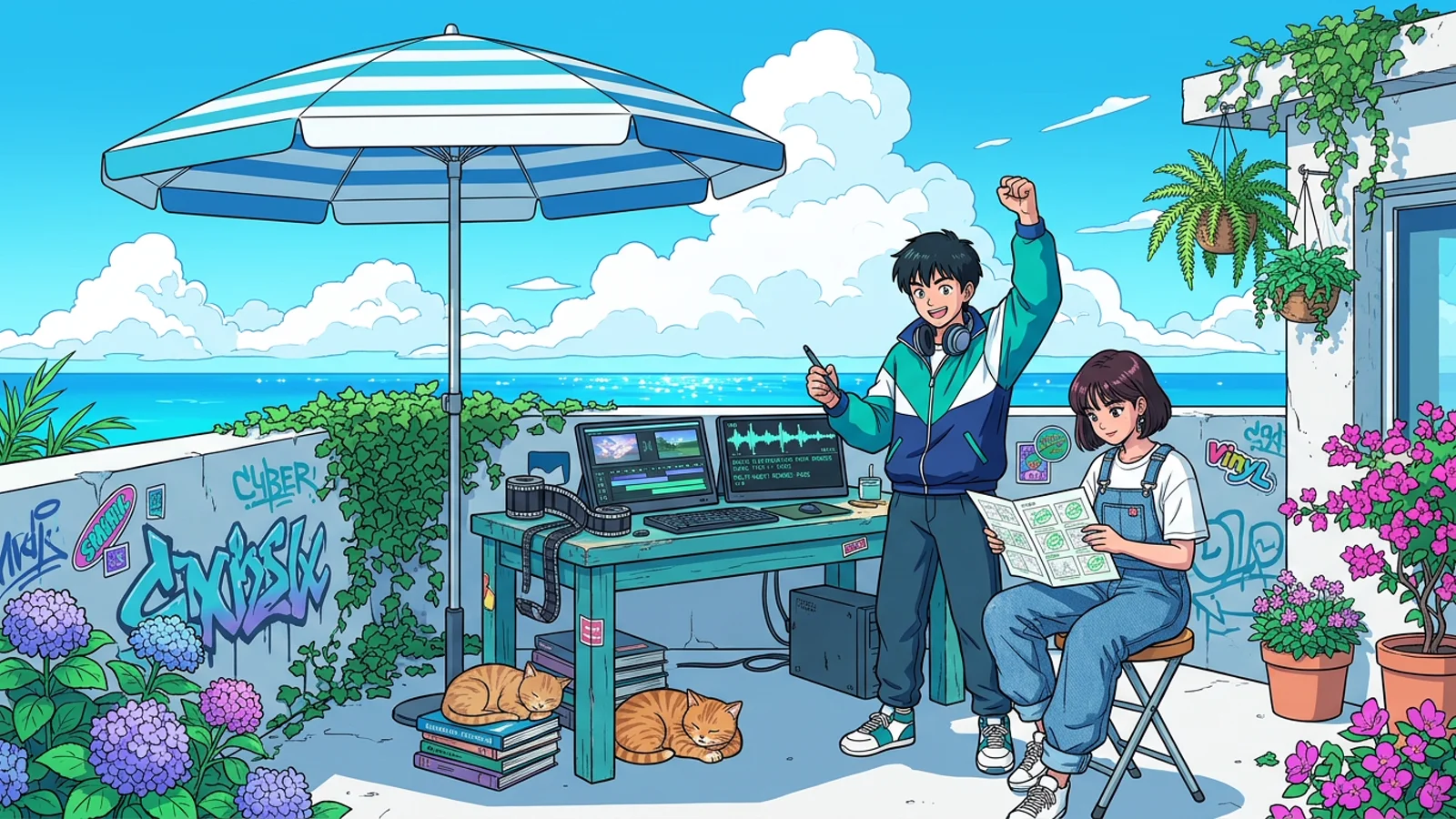
The generative video landscape is currently intoxicated by latent diffusion models. If you feed tools like Sora, Runway Gen-3, or Kling an intricate text prompt, you receive breathtaking five-second photorealistic shots. Light glistens through raindrops, textures ripple with physical fidelity, and the spectacle looks immaculate on a smartphone display.
Then you ask the model to recreate the editing rhythm of your favorite music video while changing the protagonist into an original hand-drawn cartoon.
The foundation instantly fractures. Neural diffusion networks are probabilistic pixel generators. They do not comprehend structural video editing, musical beat grids, camera pan speeds, or typographical hierarchy. If you attempt to fix an awkward arm movement in second four, the model re-rolls its random noise seed. It burns two dollars in cloud credits and spits out an entirely different scene where your protagonist has swapped clothing, the background building vanished, and a stray arm sprouted from their collarbone.
Traditional digital animation suites like Blender or After Effects offer total determinism. Yet they demand hundreds of hours dragging keyframes and slicing audio waveforms by hand. An AI coding agent running inside your terminal cannot click an Adobe dropdown menu.
Developer Eden Funf open-sourced ReelMimic (edenfunf/reelmimic): an MIT-licensed, local orchestration engine that turns autonomous terminal coding agents like Claude Code or Codex CLI into a disciplined 2D animation studio. Instead of hallucinating pixels, ReelMimic mechanically deconstructs the editing DNA of any reference video, binds it to code-driven 2D animation engines, and coordinates an adversarial crew of AI builders and reviewers to deliver broadcast-quality original animation.
TL;DR
Quick Answer Box (Google Search Featured Snippet): What is ReelMimic? An open-source local orchestration framework that transforms AI coding assistants like Claude Code and Codex into an autonomous 2D animation studio. It extracts shot lengths, BPM (beats per minute), transitions, camera moves, and color curves from any reference video using OpenCV and FFmpeg, then coordinates up to six parallel agent builders and independent adversarial reviewers to produce original 2D animated videos across seven specialized code engines.
Primary Repository: edenfunf/reelmimic · License: MIT · Runtime: Node 22.18+ / Python 3.10+ / FFmpeg / Chrome
- Reference Style Transfer Without Asset Theft: ReelMimic never copies the original footage, faces, or copyrighted audio. It extracts structural pacing metrics (shot lengths, transitions, camera speed, emotional peak placement) and maps them to clean-room original scripts.
- Human-in-the-Loop Pre-Production Gate: Before a single frame is drawn, an AI director drafts
plan.jsoncontaining the full storyboard, character sheets, and style frames. Production halts until the human creator inspects and approves the blueprint. - Adversarial Peer Review (“Nobody Grades Their Own Work”): Finished shots are immediately inspected by freshly spawned reviewer agents using 12fps strip analysis and full-resolution crops. Fixes require verifiable before/after visual proof before merging.
- Seven Code-Driven 2D Engines: Built on deterministic rendering technologies including HyperFrames (vector motion graphics), painted-animation (watercolor brush strokes), crayon-storybook, pixel art, paper cut-out stop-motion, whiteboard lineart, and anime cel.
Beginner Map (Mental Model)
Think of modern generative AI video as an eccentric oil painter. If you ask him to paint a bustling harbor scene, he creates an evocative masterpiece. But if you ask him to move a sailboat two inches to the left, he throws the entire canvas into an incinerator and paints an entirely different harbor from scratch.
ReelMimic operates like an industrial animation assembly line from the golden era of cel animation. An assistant director watches your reference film with a stopwatch, counting cuts and measuring camera pans. A storyboard artist pins sketch cards onto a corkboard for your approval. Once approved, specialized illustrators paint background layers and character rigs in parallel, while an independent quality inspector checks every acetate sheet through an eye loupe before handing the reel to the camera rostrum.

Part 1: Foundations (The AI Video Continuity Trap)
To understand why ReelMimic represents a profound architectural shift, we must confront the hidden fragility of generative diffusion pipelines: non-deterministic latency.
In web development, engineers expect programmatic contracts. If you change a button’s background color in CSS (cascading style sheets: document styling rules), only that specific element re-renders. The surrounding layout and database remain untouched.
Generative video models lack this component boundary. Every video clip is sampled as a holistic 4D tensor across spatio-temporal latents. Modifying a subtitle or correcting an arm pose requires re-evaluating the entire volume.
This introduces three critical operational failures:
- Continuity Drift: Changing a camera prompt from “slow pan” to “static shot” causes the model to hallucinate a new face and alter the room’s color palette.
- Timing Desynchronization: Diffusion models cannot lock cuts to audio transients. If music hits a sharp snare at second 4.25, diffusion casually transitions at second 3.8 or 4.7.
- Runaway Financial Burn: Because fixing an error requires full re-renders, refining a thirty-second spot routinely burns $30 to $80 in GPU credits.
| Term / Mechanism | Plain English Definition (3 to 6 words) |
|---|---|
| BPM (Beats Per Minute) | Musical tempo dictating scene cut rhythm |
| Headless Chrome (trình duyệt ngầm) | Browser running invisibly without graphical window |
| CDP (Chrome DevTools Protocol) | Low-level socket controlling browser execution |
| Frame Adapter (bộ điều hợp khung hình) | Script synchronizing animations with virtual clock |
| Adversarial QA (kiểm thử đối kháng) | Fresh agent testing another agent’s work |
| Deterministic Rendering (kết xuất xác định) | Identical code produces identical video frames |
ReelMimic resolves this paradox by treating video generation not as a statistical guessing game, but as an orchestrated software compilation task. It anchors the video timeline in deterministic web code and specialized graphics engines, using LLMs solely for high-level creative synthesis and programmatic execution.
Part 2: Investigation (Under the Hood of ReelMimic)
ReelMimic’s architecture is organized into a five-stage assembly line, governed by strict JSON data contracts defined in CONTRACT.md.
1. Acoustic & Visual Deconstruction (analyze.py)
When you provide a reference video (a local MP4 file, phone recording, or YouTube URL), ReelMimic launches analyze.py. Built on OpenCV (computer vision library) and FFmpeg (open-source audio and video processing suite), the script extracts five structural datasets:
- Shot Boundary Detection: Slices the video into discrete shots, calculating average shot duration in seconds and musical beats.
- Audio Transient Analysis: Runs onset detection to calculate musical BPM, phase alignment, and loudness curves.
- Camera Kinematics: Analyzes optical flow vectors across consecutive frames to classify camera motion (slow push-in, fast pull-back, horizontal pan, orbit, or static).
- Color Arc & Brightness Summary: Samples average luminance, contrast ratios, and dominant palette hex codes across each scene.
- Climax Detection: Locates audio spikes (
audio.peak_candidates) and rapid brightness shifts (flashes) to identify the video’s emotional climax.
The metadata compiles into analysis/report.json and 1fps contact sheets (sheet_1fps.jpg), giving the agent director exact quantitative targets.
2. Pre-Production & The Cast Gate
Unlike chaotic “one-shot prompt” tools, ReelMimic enforces an explicit human-in-the-loop planning gate. The orchestrator synthesizes plan.json, presenting the storyboard, character designs, and proposed style frames via a local web interface on port 4318. The user can chat with the director agent to refine pacing or upload character drawings. Production halts until the human explicitly clicks Approve and start.
To prevent character drift across parallel workers, ReelMimic introduces the Cast Gate. Before any scene is coded, the director agent generates centralized character rig files and cast turnaround sheets (out/check/cast/sheet.jpg). If the user provided a reference drawing in inputs/, the Cast Gate verifies proportion ratios (width to height), eye placement, and color palettes against the user’s specification. Once validated, all subsequent builders import these shared definitions verbatim.
3. Parallel Builders & Adversarial Shot QA
Once pre-production clears, ReelMimic splits the video into independent chunks and spins up parallel builder agents. To eliminate self-grading bias, ReelMimic enforces Strict Adversarial Review:
// ReelMimic reviewSlot queue: fresh reviewer spawned for every shot
const reviewShot = (sid: string, round: number) => (reviews[sid] = (async () => {
  if (!(await castP)) return false;
  const r = await reviewSlot(id, () => turn(
    id,
    'shot_qa',
    { chunk: c, shots: [sid], round, out: `out/check/shots/${sid}.review.json` },
    [`out/check/shots/${sid}.review.json`],
    { session: 'fresh', who: `shot-qa-${sid}` }
  ));
  return r.ok;
})());
Notice { session: 'fresh', who: 'shot-qa-' + sid }. The agent that builds a shot cannot grade it. An independent agent instance inspects 12fps continuous film strips and full-resolution crops against a strict checklist:
- Are character limbs connected without floating joints?
- Does character scale match scene intent (protagonist occupying at least 35% of frame height during dialogue)?
- Are captions legible when scaled down to a 390px mobile viewport?
- Did any frame flash black or drop frames between camera cuts?
Defects are categorized as polish (minor aesthetic suggestions) or blocker (dislocated limbs, broken typography, missing transitions). Blockers return to the builder, requiring verifiable before/after screenshot diffs before approval.
Part 3: Diagnosis (The Rough Edges & Operational Traps)
While ReelMimic solves the continuity nightmares of diffusion models, running an autonomous animation studio locally introduces substantial engineering trade-offs.
Developer discussions on X reflect both enthusiasm and operational reality:
However, deploying ReelMimic on local workstations quickly surfaces token economics and compute boundaries:
Trap 1: The Multi-Agent Token Avalanche
ReelMimic runs through your local Claude Code or Codex CLI subscription. While this eliminates separate software licensing fees, parallel multi-turn agent conversations consume tokens rapidly.
Because every shot requires an authoring turn, a headless test run, an adversarial review turn, and potential fix iterations, a 60-second video routinely consumes between 800,000 and 2,000,000 tokens. This can exhaust standard hourly limits on Claude Code. Fortunately, ReelMimic stores execution state in projects/<id>/pipeline.json. If a run terminates due to quota limits, rerunning the pipeline resumes from the last passed chunk.
Trap 2: The 2D-Only Animation Boundary
Engineers expecting photorealistic AI film production must understand ReelMimic’s boundaries: it is strictly designed for 2D animation and motion graphics.
The engine author explicitly disables 3D photorealistic engines. The seven supported drawing engines focus entirely on stylized visual mediums:
- HyperFrames: Motion graphics, kinetic typography, and vector UI walkthroughs.
- Painted-Animation: Hand-painted watercolor illustrations with algorithmic brush pathing.
- Crayon-Storybook: Colored pencil texture simulation for whimsical narratives.
- Pixel-Art & Paper-Cutout: Retro 8-bit sprite work and stop-motion card layers.
Feeding ReelMimic a live-action Hollywood scene maps the cinematic rhythm into an anime cel or vector interpretation. It will not generate real human video.
Part 4: Resolution (Decision Matrix & Setup Guide)
| Evaluation Dimension | Adopt ReelMimic Immediately | Avoid or Use Alternative |
|---|---|---|
| Target Medium | 2D motion graphics, kinetic text, anime cel, watercolor cartoons | Photorealistic live-action video with real human actors |
| Pacing Requirements | Music videos, strict audio-synced promos, frame-accurate cuts | Ambient, slow-moving cinematic b-roll with zero beat sync |
| Execution Budget | Have active Claude Code Max or Codex CLI subscriptions | Zero-token budget or looking for free one-click instant generation |
| Editing Control | Need programmatic control to tweak one shot without touching others | Prefer rolling dice on random prompts without editing needs |
Operational Setup (Quickstart)
Ensure your workstation has Node.js 22.18+, Python 3.10+, FFmpeg, and an active login for either Claude Code or Codex CLI.
# 1. Clone the repository
git clone https://github.com/edenfunf/reelmimic.git
cd reelmimic

# 2. Run automated environment doctor
./install.sh

# 3. Launch local studio web interface
./start.sh
Navigate to http://localhost:4318. Drop your reference video into the upload tray, specify your narrative brief, select your agent engine (Claude Code or Codex), and review your generated storyboard before kicking off production.
Final Take
Diffusion video models will continue generating mesmerizing sensory dreams, but production engineering requires predictable execution contracts. ReelMimic proves that the future of AI video authoring belongs to disciplined crews of autonomous agents writing, inspecting, and compiling deterministic code.
Student First Assignment
- Clone
edenfunf/reelmimicand runcd app && npm run doctorto verify local FFmpeg, Chrome, and Claude Code binaries. - Select a 15-second kinetic typography video or animated intro from YouTube.
- Ingest the clip through
python .claude/skills/video-clone/scripts/analyze.py "<url>" --out test_analysis. - Inspect
test_analysis/report.jsonto examine how optical flow, shot cut durations, and audio BPM are extracted into structured JSON before writing your first agent brief.
Frequently Asked Questions (FAQ)
Does ReelMimic reuse or copy assets from the reference video?
No. ReelMimic uses OpenCV and FFmpeg exclusively to analyze editing mathematics: shot durations, camera angles, color schemes, and audio beat points. All visual assets, character rigs, and animation code generated during production are clean-room original creations.
How does ReelMimic prevent AI hallucination and character drift?
ReelMimic isolates character creation inside a dedicated Pre-Production Cast Gate. Before any scene is coded, the director agent generates centralized character rig files and turnaround sheets. Subsequent builder agents import these shared files directly, preventing stylistic drift.
Can I run ReelMimic with local open-source LLMs like Llama or Mistral?
Currently, ReelMimic’s orchestrator relies on the tool execution protocols and sub-agent calling architectures native to Claude Code CLI and OpenAI Codex CLI. Supporting local inference engines requires implementing custom headless adapters compatible with their JSON stream parser.
Related posts
- AI & Agents
HyperFrames Explained: Write HTML. Render Video. Built for Agents
How HeyGen's HyperFrames turns standard HTML, CSS, and seekable animations into deterministic MP4 videos, giving AI coding agents full programmatic video control.
12 min readRead → - AI & Agents
API Anything Explained: Turn Any Website into Fast Agent Tooling
How API Anything captures frontend network traffic once, learns request slots without LLMs, and replaces heavy browser automation with 120ms self-healing HTTP APIs.
12 min readRead → - AI & Agents
CleanYourTV Explained: Strip Smart TV Bloat via Claude Code
How CleanYourTV uses Claude Code and ADB over Wi-Fi to strip Google TV bloatware, eliminate sponsored ads, and deploy a 526KB Apple TV launcher.
12 min readRead → - AI & Agents
One minute of 720p video from a single GPU - how did we get here so fast?
SANA-WM is a 2.6B open-source world model that generates minute-long 720p video with 6-DoF camera control on one GPU. NVIDIA trained it on 64 H100s in 15 days.
5 min readRead →