Hugging Face Skills: The 'Plug-and-Play' Mental Model for AI Agents
What are Hugging Face Skills? A mastery guide to empowering Claude Code, Cursor, and Gemini CLI with open-source ML capabilities.

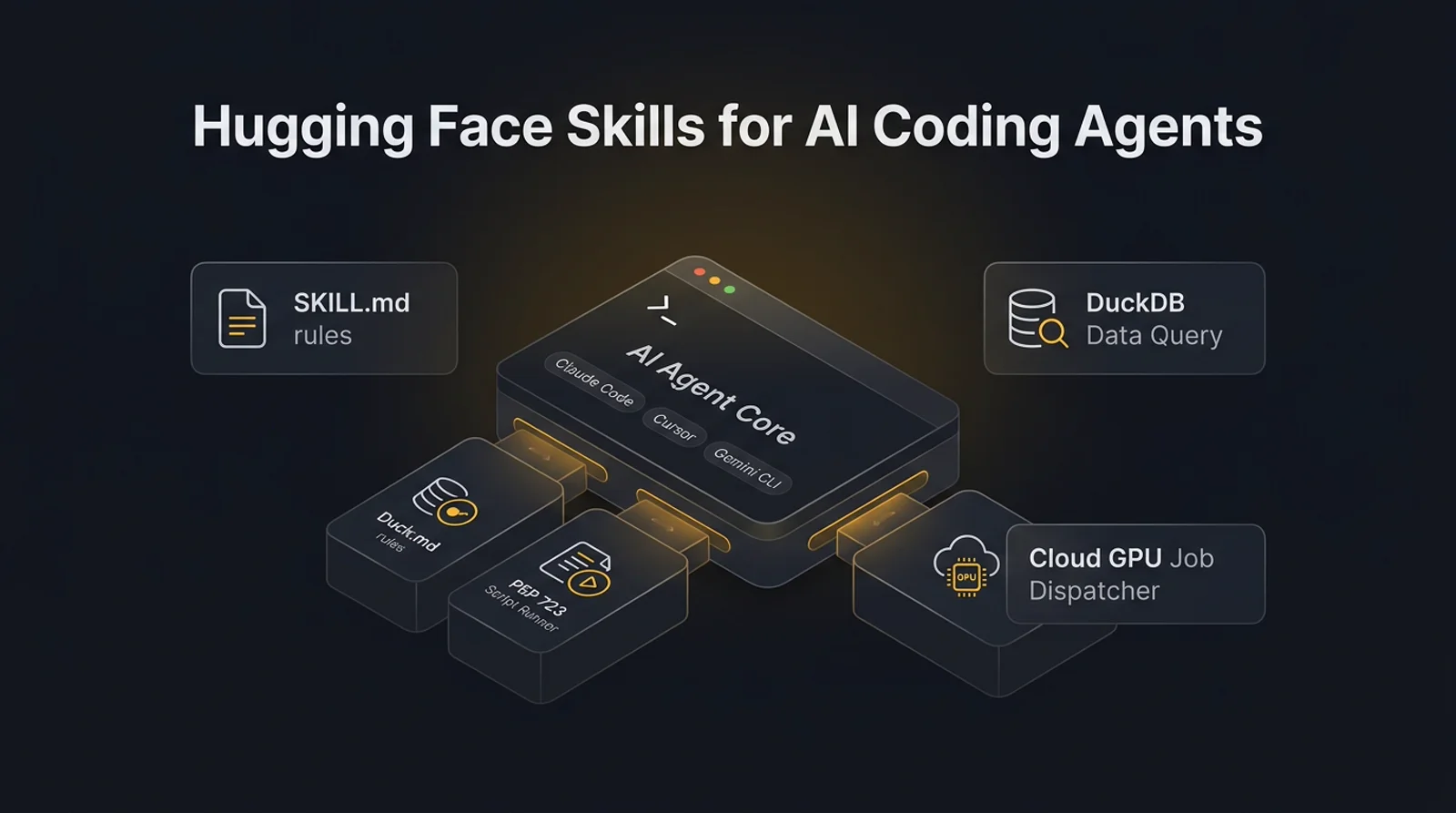
TL;DR
Raw LLMs are powerful thinkers but terrible executors when asked to perform specialized ML workflows. Hugging Face Skills standardizes capabilities into portable directory packages containing clear rules (SKILL.md), self-contained Python scripts powered by uv inline dependencies (PEP 723), and reference templates. This allows coding agents like Claude Code, Cursor, and Gemini CLI to query remote datasets with DuckDB and dispatch cloud GPU fine-tuning jobs with zero local environment pollution.
Beginner Map: The 3-Tier Agent Capability Hierarchy
To understand why standardizing skills matters, compare the three levels of AI agent tooling:
| Tier | Name | What the Agent Receives | Real-World Failure Mode |
|---|---|---|---|
| Tier 1 | Raw LLM Prompts | Plain text instructions copy-pasted into chat. | Hallucinates CLI flags, mixes package versions, trashes host environments. |
| Tier 2 | Low-Level Shell Tools | Blind bash execution access. | Spends dozens of turn iterations debugging basic syntax and missing environment variables. |
| Tier 3 | Standardized Skills | Self-contained folder with SKILL.md and uv scripts. |
One-shot execution with zero dependency drift across Claude, Cursor, and CLI agents. |
Part 1: Foundations (The Mental Model)
An AI Agent without skills is like a brilliant engineer without a laptop.
A Skill gives the agent the exact tools, scripts, and context it needs to execute a specific job reliably.
The Hugging Face Skills repository establishes a standardized specification to equip AI agents with dataset curation, model training, and evaluation workflows.
AI Agent = The Smart Employee
An AI Agent is an LLM with tool-calling capabilities. However, raw tools (like a generic Python code executor or a shell tool) are often too low-level. The agent might spend hours figuring out the right API parameters.
Skills = The Employee Handbook + Specialized Tools
A Skill is a self-contained folder that packages:
- Instructions (
SKILL.md): The exact operational boundaries and step-by-step guidelines the agent must follow. - Scripts: Python code or shell scripts with inline dependencies ready to run.
- Resources: Templates, evaluation schemas, or reference configs.
Agent Request: "Train a 7B model using TRL on Hugging Face Jobs."
         │
         ▼
[Agent Loads Skill]: hugging-face-model-trainer
         │ Reads SKILL.md (Rules: Check VRAM, Estimate Cost, Use TRL)
         ▼ (Action)
[Agent Automatically Executes Skill Scripts]
         │
         ▼
[Output]: "Model training started. Track here: [URL]"
It bridges the gap between what an Agent can do theoretically, and what it will do efficiently.
As detailed in our guide on Agent Skills and Context Engineering and the minimalist architecture of Pi-Mono, organizing instructions into structured directories radically reduces hallucination rates.
Part 2: The Investigation (Cross-Platform Compatibility)
The most compelling aspect of Hugging Face Skills is that it acts as a universal adapter. It uses the Agent Skill format, making it interoperable with modern coding agents:
- Claude Code: Add the marketplace (
/plugin marketplace add huggingface/skills) and install specific skills. - Cursor: Load the
.cursor-plugin/plugin.jsonor MCP setup. - Gemini CLI: Install via
gemini extensions install. - OpenAI Codex: Automatically picks up the
AGENTS.mdinstructions.
You do not need to write separate prompts for different IDEs. The Skill standardizes the knowledge base.
When combined with local inference platforms like LM Studio, these skills can orchestrate local models and cloud training jobs interchangeably.
Part 3: The Diagnosis (What It Actually Does for Python Developers)
If you are a Python developer building AI applications, the phrase “MLOps” usually means painful environment setup. Hugging Face Skills shifts this paradigm. By default, the repository gives your agent an instant PhD in MLOps, powered by uv inline dependencies (PEP 723). This means the agent’s scripts run in isolated environments on-demand.
Here is how that improves your workflow:
1. SQL Querying Hugging Face Datasets (DuckDB)
The hugging-face-datasets skill allows your agent to query remote datasets directly using the hf:// protocol via DuckDB. There is no need to download terabytes of data locally just to extract a few rows:
# The agent automatically uses tools to execute SQL against the Hub:
uv run scripts/sql_manager.py query \
  --dataset "cais/mmlu" \
  --sql "SELECT * FROM data WHERE subject='nutrition' LIMIT 10"
2. Zero-Setup Cloud GPU Training
With the hugging-face-model-trainer skill, your agent can spin up cloud GPUs (like A10G or A100) dynamically using Hugging Face Jobs. You specify the parameters, and the agent writes the training script and executes it remotely:
# The agent calls its MCP tool hf_jobs() with a fully isolated inline script:
hf_jobs("uv", {
    "script": """
# /// script
# dependencies = ["trl>=0.12.0", "peft>=0.7.0"]
# ///
from trl import SFTTrainer
# ... agent's custom training implementation ...
trainer.train()
trainer.push_to_hub()
""",
    "flavor": "a10g-large",
    "timeout": "2h",
    "secrets": {"HF_TOKEN": "$HF_TOKEN"}
})
This is an architectural leap. The LLM writes the training script, injects dependencies in the header, requests the exact GPU hardware, and automatically saves the resulting model back to the Hugging Face Hub asynchronously.
3. Local Deployment (GGUF Conversion)
It does not just train, it deploys. The model-trainer skill includes scripts to automatically convert your newly fine-tuned model into GGUF format, making it instantly loadable in local inference tools like Ollama or LM Studio.
Student First Assignment
To experience modular skill architecture firsthand, build your own custom data inspection skill in 15 minutes:
- Create the skill folder layout:
mkdir -p my-dataset-inspector/scripts touch my-dataset-inspector/SKILL.md - Define strict operational rules in
SKILL.md: Specify that the agent must query dataset schemas with DuckDB before downloading any raw files. - Write a self-contained script with PEP 723 header:
# /// script # dependencies = ["duckdb>=0.9.0"] # /// import duckdb print(duckdb.query("SELECT 42 as answer").fetchall()) - Test execution: Run
uv run --isolated my-dataset-inspector/scripts/inspect.pyand confirm the agent completes the task without touching your global virtualenv.
Part 4: The Resolution (Building Your Own Skill)
Hugging Face skills are completely open source. You can fork them and build your own company’s internal skills using the same structure.
The structure is intentionally simple:
my-awesome-skill/
├── SKILL.md         # The main prompt and instruction file
├── scripts/         # Reusable scripts (leveraging UV and PEP 723)
└── templates/       # Boilerplate code you want the LLM to use
When you tell Claude: “Use my-awesome-skill to do X”, it loads everything in that folder into its context window and executes with high fidelity. For example, similar to how our ADHD Coding Agent Skill enforces micro-commits and context boundaries, the hugging-face-tool-builder skill trains the agent to create composable Python utilities that pipe JSON streams cleanly.
Final Take
- Agent: The smart employee (Claude Code, Cursor, Antigravity).
- Tools: Raw tools (Python, Bash, Search).
- Skill: The Standard Operating Procedure (SOP) plus specialized gear.
- The Modern Shift: Stop copy-pasting 50-page system prompts into chat boxes. Treat agent capabilities like production code by packaging them into Git-tracked, modular skill repositories.\n
Related posts
- AI & Agents
OpenHuman Explained: The 40k-Star Local AI Superintelligence & Obsidian Memory Engine
Explore OpenHuman, the 40k-star open-source local AI superintelligence featuring Karpathy Obsidian memory trees, TokenJuice, and multi-agent graphs.
11 min readRead → - AI & Agents
Tencent BrowserSkill Explained: How AI Uses Your Logged-In Browser
Tencent BrowserSkill lets AI agents use your logged-in Chrome without stealing focus. Explore tab borrowing, captcha handling, and local daemon architecture.
7 min readRead → - AI & Agents
High-Leverage Coding Terms & Jargon for AI Coding Agents
Discover the architectural keywords and high-leverage engineering jargon that turn AI coding agents into precision tools, eliminating hallucinations.
9 min readRead → - AI & Agents
What AI DevKit is: a control plane for AI coding agents - and where it stops
An architectural guide to AI DevKit: local-first CLI/TUI console, shared config, SQLite memory, and workflow skills for managing multiple coding agents.
12 min readRead →