BitNet: The Era of 1-bit LLMs is Finally Here
Explore bitnet.cpp, Microsoft's official framework for 1-bit LLMs that replaces multiplications with additions for massive speedups.

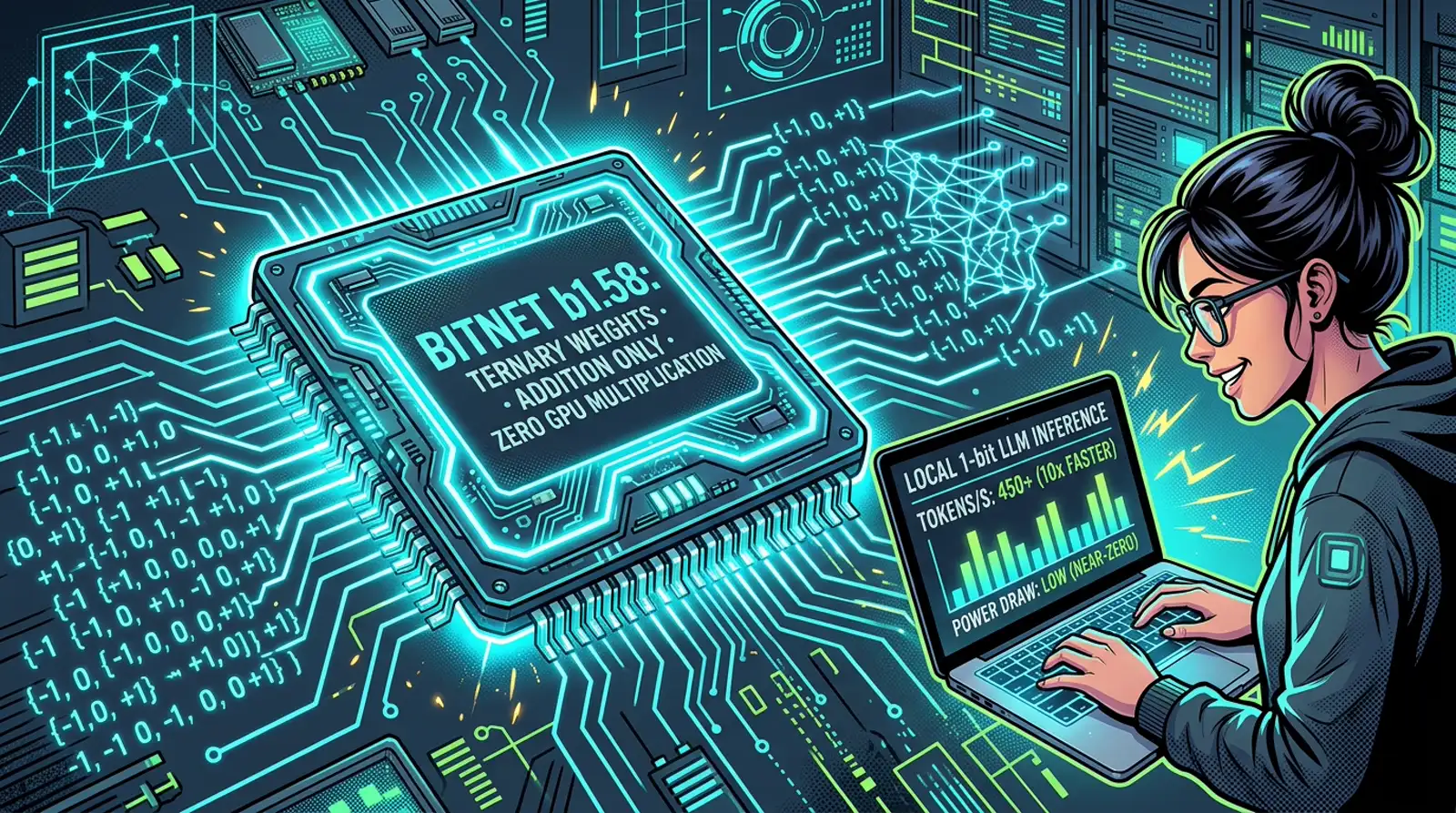
BitNet: The Era of 1-bit LLMs is Finally Here
For years, we’ve been trying to squeeze Large Language Models (LLMs) into smaller packages using quantization (INT8, INT4). But Microsoft just changed the game. Welcome to the era of 1-bit LLMs.
Part 1: Foundations (The Mental Model)
To understand BitNet, specifically the BitNet b1.58 variant, you need to change your mental model of how an AI “thinks.”
Traditional LLMs rely on massive amounts of floating-point multiplications (Matrix Multiplications). BitNet transforms the LLM from a Multiplication Machine into an Addition Machine.
In the 1.58-bit world, weights are ternary: they can only be -1, 0, or 1. This means the model doesn’t need to multiply numbers; it only needs to add or subtract them based on these ternary values.
The mental model: Efficiency isn’t just about smaller numbers; it’s about simpler operations.
Part 2: The Investigation
The project bitnet.cpp is the official inference framework for these 1-bit models. It’s built on top of the battle-tested llama.cpp but introduces specialized kernels (like I2_S) designed specifically for ternary math.
Key architectural highlights:
- Custom Kernels: Optimized for both x86 (AVX2) and ARM (NEON/DOTPROD) architectures.
- Lookup Table Strategy: Uses methodologies from T-MAC to speed up low-bit operations.
- Lossless Inference: Despite the extreme quantization, 1.58-bit models maintain performance remarkably close to their full-precision counterparts.
Part 3: The Diagnosis
What does this actually mean for developers? The impact is staggering, particularly for local inference on consumer hardware.
The Numbers (CPU Performance)
- x86 CPUs: Speedups ranging from 2.37x to 6.17x.
- ARM CPUs: Speedups of 1.37x to 5.07x.
- Energy Efficiency: A massive 70% to 80% reduction in energy consumption.
- The “Human Reading” Milestone: You can run a 100B parameter model on a single CPU at speeds comparable to human reading (5-7 tokens/sec).
Deep Dive: Optimization Features
Recent updates have introduced “Activation Parallelism,” which amortizes the cost of weight unpacking across multiple elements, further boosting throughput for prompt processing (GEMM) and token generation (GEMV).
# The setup process is highly automated via Python scripts
# Quantizing embeddings to Q6_K balances memory and speed
python setup_env.py -md models/BitNet-b1.58-2B-4T -q i2_s --quant-embd
Part 4: The Resolution
Ready to run a massive LLM on your laptop’s CPU? Here is the path:
- Clone the Repo:
git clone --recursive https://github.com/microsoft/BitNet. - Build from Source: Install dependencies (
python,cmake,clang) and run the setup script. - Download the Model: Use
huggingface-clito grab the GGUF version ofBitNet-b1.58-2B-4T. - Inference: Run
run_inference.pyto start chatting.
python run_inference.py -m models/BitNet-b1.58-2B-4T/ggml-model-i2_s.gguf -p "Explain quantum computing in simple terms" -cnvFinal Mental Model
BitNet = Ternary Weights + Addition-Only Kernels + Local Scalability.
It represents a paradigm shift where memory bandwidth and energy are no longer the absolute bottlenecks for large-scale AI. By simplifying the fundamental math of LLMs, BitNet makes the “100B model on a CPU” a reality today.
Related posts
- AI & Agents
FP4: the 16-value float powering billion-parameter models
FP4, a 4-bit float with just 16 representable numbers, is now the default inference format for billion-parameter models on NVIDIA Blackwell hardware.
6 min readRead → - AI & Agents
The Wildly Simple Architecture Running Our AI Moment
A ground-up walkthrough of how transformer-based LLMs actually work - tokens, embeddings, attention, and the next-token loop - and why HN engineers can't…
5 min readRead → - AI & Agents
9Router: What It Is, Free AI Coding & Tiered Fallback Gateway Guide
What is 9Router? Complete guide to the open-source local proxy: multiplex 40+ LLMs, auto-fallback on quota limits, and 20-40% token compression for coding agents.
10 min readRead → - AI & Agents
Open CTFs Are Now Pay-to-Win, and Frontier AI Did It
A top-10 CTF competitor argues that Claude Opus 4.5 and GPT-5.5 have automated enough of the scoreboard that open CTFs no longer measure human security skill.
5 min readRead →