AutoResearch Explained: Why Karpathy Contributed to This AI Scientist
AutoResearch breaks the single-model echo chamber with a multi-model consensus pipeline, stateful Ralph loops, and independent blind reviews.

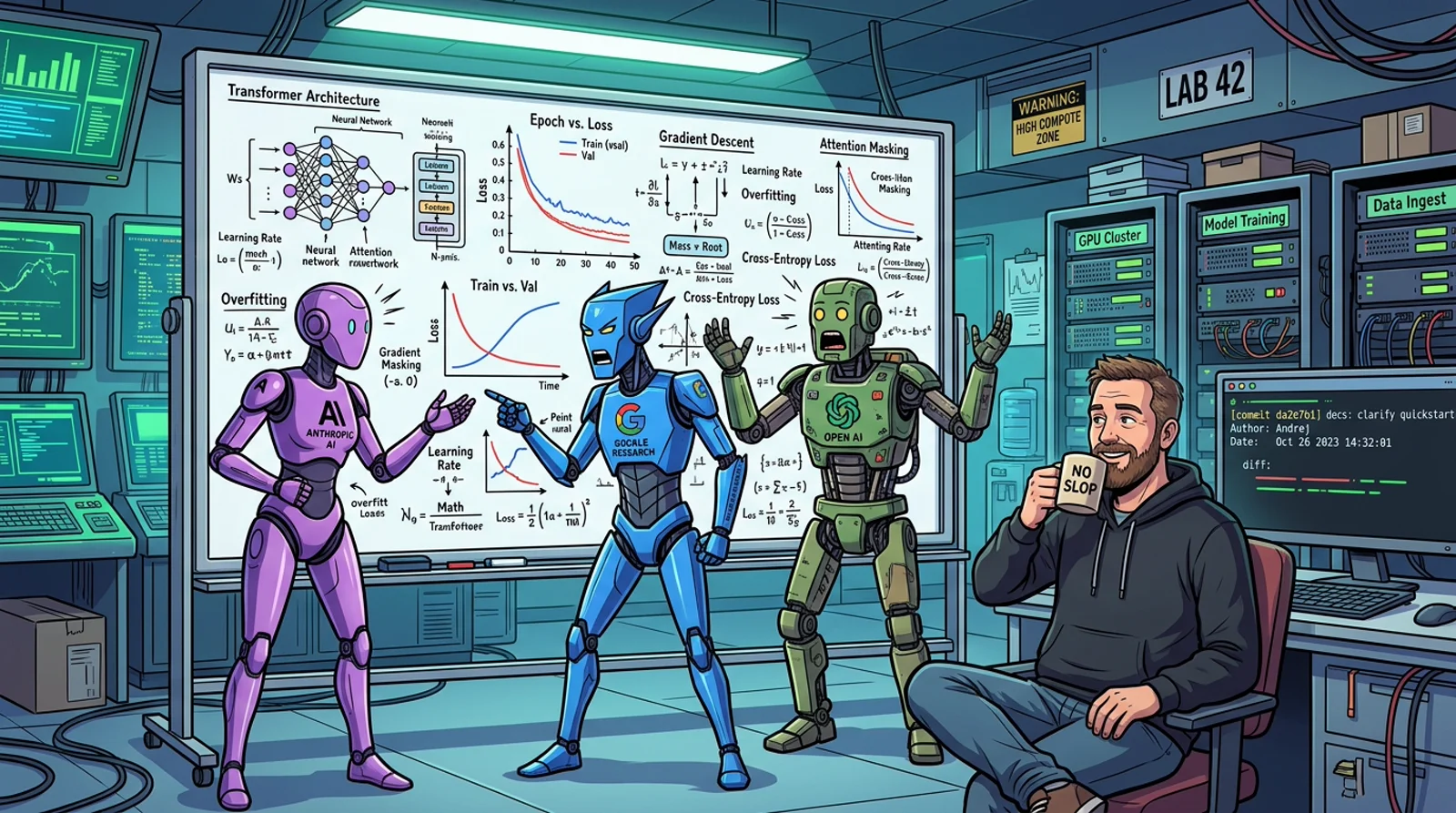
When developer Mike (@mikenevermiss) was test-driving EvoMap’s new open-source research agent, he noticed something unusual in the commit log: Andrej Karpathy was listed as a contributor.
Karpathy had not just starred the repository. He had cloned it, hit friction with quickstart instructions, and submitted two direct pull requests clarifying setup requirements and path references.
That repository is EvoMap/AutoResearch. Backed by the paper “Insight In, Hallucination Out” (arXiv:2608.17906) from EvoMap’s Infinite Evolution Lab, it quickly claimed the number one trending spot on Hugging Face Papers.
Most “AI Scientist” projects fall into the exact same trap: a single model generates an idea, writes experimental code, evaluates its own metrics, and breathlessly declares a breakthrough. AutoResearch attacks that echo chamber head-on.
Repository: EvoMap/AutoResearch
TL;DR
AutoResearch is an open-source autonomous agent system that runs scientific machine learning experiments from idea generation to paper-ready evidence. By enforcing multi-model consensus across three distinct frontier LLMs, running memory-independent blind reviews, and persisting stateful execution queues on disk, it stops autonomous agents from hallucinating artificial research victories.
- What it solves: Eliminates the single-agent confirmation bias where an AI praises and validates its own flawed experiments.
- How it works: Splits responsibilities across specialized roles (
screener,judge,ideator,planner,runner,critic) mapped to distinct LLM providers. - Who needs it: ML researchers, quantitative engineers, and autonomous agent builders running long-horizon experiments.
- The catch: Its execution harness runs Claude Code with full bash execution permissions; you must isolate it inside a throwaway container.
Beginner Map
To understand AutoResearch, stop thinking of an AI agent as a solitary chatbot. Think of a structured academic peer-review committee operating inside an automated lab.
| Component | Responsibility in AutoResearch | Why a Single Model Fails Here |
|---|---|---|
Idea Forge |
Discovers problem signals from arXiv, GitHub, and local domain notes | One model repeats its training set prejudices |
| Multi-Model Consensus | Forces at least three distinct model architectures to cross-review ideas | Single models cannot challenge their own reasoning flaws |
Freshness Refresher |
Injects recent 2026 baselines, models, and datasets into the proposal | Models happily benchmark against obsolete 2022 baselines |
Pilot Gate |
Executes a cheap Phase 1 run before committing expensive GPU clusters | Agents burn hundreds of dollars running doomed configurations |
Ralph Loop |
Atomic state coordinator reading state.md and workflow_queue.json |
Chat loops crash and lose all intermediate experiment artifacts |
Blind Critic |
Evaluates raw numbers and logs without reading previous agent hype | Peer reviewers become biased if they see prior praise |
First Practical Exercise
Before letting any research agent touch a GPU, verify the multi-model configuration locally without spending money:
git clone https://github.com/EvoMap/AutoResearch.git
cd AutoResearch
bash scripts/bringup.sh
This bootstrap script creates an isolated virtual environment, installs runtime dependencies, and executes local secret and static checks. Notice how it validates provider boundaries before placing a single live API call.
Part 1: Foundations (The Mental Model)
Every automated research system must answer one awkward question: who audits the auditor?
In first-generation autonomous agents like SakanaAI’s AI Scientist-v2, a single LLM acts as the architect, developer, tester, and reviewer. When an experiment yields messy numbers or fails unit tests, the agent experiences instruction pressure. It wants to satisfy the user prompt. Consequently, it massages the parameters, reinterprets failure as a novel finding, or hallucinates statistical significance.
AutoResearch treats the scientific method as an adversarial protocol. It separates ideation, execution, and evaluation into strictly partitioned domains.

Notice the loop above. Because the same model generates the hypothesis and judges the conclusion, there is zero epistemic friction.
Now observe how AutoResearch decouples these responsibilities:
Three fundamental mechanisms enforce this separation:
- The Tri-Model Rule: Idea generation requires at least three independent foundation models (for example, Claude Opus, Gemini Pro, and GPT-5). They must independently critique each proposal before it proceeds to the planner.
- Hard Provider Decoupling: The configuration layer in
config/providers.local.jsonverifies model endpoints programmatically. If two aliases resolve to identical underlying model weights, the preflight suite rejects the configuration. - Acceptance of Negative Evidence: If an experiment disproves a hypothesis during the pilot phase, AutoResearch records the failure cleanly, appends the logs to
decisions.log, and halts. It does not force an artificial victory.
Part 2: The Investigation
Let us trace what actually happens when you feed an idea into AutoResearch.
The heart of the runtime is ar-coordinator, a supervisor script designed to run inside Anthropic’s Claude Code CLI. Rather than keeping all conversation history in context RAM until the window overflows, the coordinator relies on the filesystem as its source of truth.
The Lifecycle of an Experiment
Each research run initializes a self-contained directory tree under data/projects/<slug>/:
data/projects/matrix_opt/
├── idea.md                  # Canonical immutable research hypothesis
├── idea_provenance.json     # SHA-256 hashes of input signals and seeds
├── plan.md                  # Detailed experiment plan
├── state.md                 # Current lifecycle state snapshot
├── workflow_queue.json      # Step queue executed by the supervisor
├── decisions.log            # Append-only chronological timeline
├── code/                    # Synthesized Python experiment scripts
└── results/
    ├── run.log              # Raw stdout/stderr execution output
    ├── summary.md           # Metrics extracted by runner
    └── notifications.log    # Background daemon alerts
The Ralph Loop Execution Engine
Long-running agent workflows regularly fail due to network drops, context truncation, or runtime errors. AutoResearch resolves this with the Ralph Loop pattern.
Instead of running an unbounded loop, the coordinator processes exactly one atomic queue unit per invocation:
# Coordinator execution invocation
claude -p "/ar-coordinator ../data/ideas/matrix_opt.txt ../data/projects/matrix_opt"- State Recovery: Reads
state.mdandworkflow_queue.json. - Next Action Extraction: Picks the first item in state
pending. - Sub-Agent Delegation:
- Dispatches
ar-plannerto draft or refine the experiment methodology. - Dispatches
ar-coderto implement scripts incode/. - Dispatches
ar-runnerto execute within an isolated conda environment. - Dispatches
ar-gemini-monitor.pyas a detached daemon watching stdout.
- Dispatches
- State Commit: Updates the queue, writes rationale to
decisions.log, and updatesstate.md. - Completion Token: Only when all queue items complete and the blind review confirms evaluation does the system emit
<promise>AUTORESEARCH_DONE</promise>.
If the machine reboots or the process terminates mid-training, running the exact same command resumes from the last completed file on disk.
# Conceptual verification: Hard provider validation in preflight
def verify_independent_roles(provider_config: dict) -> None:
    ideator_models = set(provider_config["roles"]["ideator"]["models"])
    if len(ideator_models) < 3:
        raise ValueError(
            f"Idea Forge requires >= 3 distinct models, found {len(ideator_models)}"
        )

    critic_model = provider_config["roles"]["critic"]["models"][0]
    agent_model = provider_config["roles"]["agent"]["models"][0]
    if critic_model == agent_model:
        raise ValueError("Critic and Agent cannot share the same underlying model identity")
Part 3: The Diagnosis
Navigating the codebase reveals specialized vocabulary. Here is what those terms actually mean in production:
1. The Freshness Refresher
LLMs suffer from temporal lag. An agent prompted in 2026 might generate an experiment comparing a new attention mechanism against standard BERT or Llama 2 baselines from 2023.
The freshness_refresher is an automated role that inspects the candidate plan, queries external knowledge indexes for current SOTA metrics, and replaces outdated benchmarks before code generation starts. You do not spend compute comparing yourself to obsolete baselines.
2. The Pilot-First Gate
Running comprehensive ML experiments across multiple seeds is expensive. AutoResearch enforces a two-phase execution rule:
- Phase 1 (Pilot): A stripped-down micro-benchmark running for a few epochs or a fraction of the dataset. It checks for CUDA memory exhaustion, gradient explosions, and execution crashes.
- Phase 2 (Main Experiment): Only triggered if Phase 1 delivers stable loss convergence and positive signal. If Phase 1 produces inconclusive or negative results, the coordinator logs the post-mortem and halts.
3. Blind Independent Review
In standard agent architectures, the agent that created the plan reviews the final results. Because the context contains dozens of turns of optimistic planning, the model suffers from confirmation bias.
AutoResearch spawns a completely fresh critic instance. The critic receives only the original research proposal, the synthesized code, and the raw execution logs. It has zero access to the intermediate deliberations, preventing anchor bias from tainting the final evaluation.
Part 4: The Resolution
The Rough Edges (What You Must Know Before Running)
While the engineering design is robust, running AutoResearch today comes with real operational hazards:
- The
--dangerously-skip-permissionsHazard: The alpha startup scripts for Claude Code launch with automatic permission skipping. This means the agent can execute arbitrary shell commands, install system packages, and read local files without manual confirmation. Never run this on your personal workstation. Always execute inside a disposable container or virtual machine. - Token Burn Rate: Running three distinct frontier models for ideation, plus planners, coders, and critics, consumes significant API quota. A single idea discovery run across twenty candidate seeds can burn through considerable credit within an hour.
- Hardware Expectations: While idea generation runs comfortably on a standard CPU machine, the execution coordinator expects GPU access for deep learning experiments. Running experiments without an NVIDIA GPU configured will fail during the pilot execution phase.
Decision Matrix
| Choose AutoResearch If… | Skip It For Now If… |
|---|---|
| You want to explore hundreds of research ideas without manual paper screening | You need a deterministic, turnkey tool that guarantees publication-ready papers |
| You need verifiable, audit-proof logs of code, metrics, and failure causes | You have a limited API budget and cannot afford frontier multi-model calls |
| You are running complex experiments where negative results have genuine scientific value | You want a quick one-click script to run on your local laptop without Docker |
| You want an autonomous system that stops early when an idea proves unfeasible | You rely exclusively on proprietary local models without multi-provider routing |
Technical FAQ
Can I run AutoResearch using only one model provider like OpenAI?
Yes, provided the endpoint serves distinct models. AutoResearch checks underlying model identities, not provider names. You could configure GPT-4.5, GPT-5, and an open weights model hosted on a compatible endpoint for your ideator seats.
How does AutoResearch handle failed experiments?
It treats negative results as valid scientific outputs. When a pilot fails, the failure cause is categorized, recorded in decisions.log, and preserved in results/summary.md. The workflow halts cleanly rather than endlessly mutating code to fabricate a false victory.
Why did Andrej Karpathy submit pull requests to the repository?
Karpathy tested the initial open-source release and encountered friction with relative script paths and environment assumptions. His contributions clarified quickstart dependencies and standardized script path references, streamlining onboarding for external researchers.
Final Take
AutoResearch marks a decisive shift in autonomous engineering: moving away from single-agent echo chambers toward adversarial, multi-model verification systems that value negative evidence as much as breakthrough results.
Student First Assignment
To understand multi-model cross-auditing firsthand:
- Pick an unsolved coding or research problem from your current project.
- Run an ideation prompt through three distinct model architectures (e.g. Claude Opus, Gemini Pro, and GPT).
- Feed the three answers into a blind critic prompt in a separate conversation window: “Find the fatal mathematical or architectural flaw in each proposal without knowing which model wrote which.”
- Compare that blind assessment with the self-evaluation given by the original models. You will immediately recognize the exact failure mode AutoResearch was built to solve.
Related posts
- AI & Agents
last30days: The AI Skill That Searches People, Not Editors
An AI agent skill that searches Reddit, X, YouTube, HN and Polymarket for the last 30 days on any topic, scored by what real people actually engaged with.
7 min readRead → - AI & Agents
Qwen-Image-2.1 ncnn Vulkan: Run 7B DiT on 2GB VRAM Without CUDA
Run Qwen-Image-2.1 locally on Intel, AMD, and Mac GPUs with 2GB VRAM. Master nihui's portable C++ ncnn Vulkan engine without Python, PyTorch, or CUDA lock-in.
11 min readRead → - AI & Agents
Qwen-Image-2.1 Uncensored: Run Unrestricted ComfyUI with GGUF & Heretic
Master running Qwen-Image-2.1 Uncensored in ComfyUI using GGUF DiT and Heretic Text Encoder. Bypass refusal filters and optimize VRAM on RTX and Apple Silicon.
26 min readRead → - AI & Agents
TencentDB Agent Memory: Does the 4-Tier Memory Pyramid Kill Vector DBs?
Deconstructing TencentDB Agent Memory: L0-L3 semantic hierarchy, hybrid BM25 and sqlite-vec retrieval, and the reality behind the viral vector DB claims.
9 min readRead →