MiroFish: Rehearsing the Future in an AI Social Sandbox
Discover MiroFish, a universal swarm intelligence engine that uses multi-agent simulations to predict future trajectories in a digital mirror world.

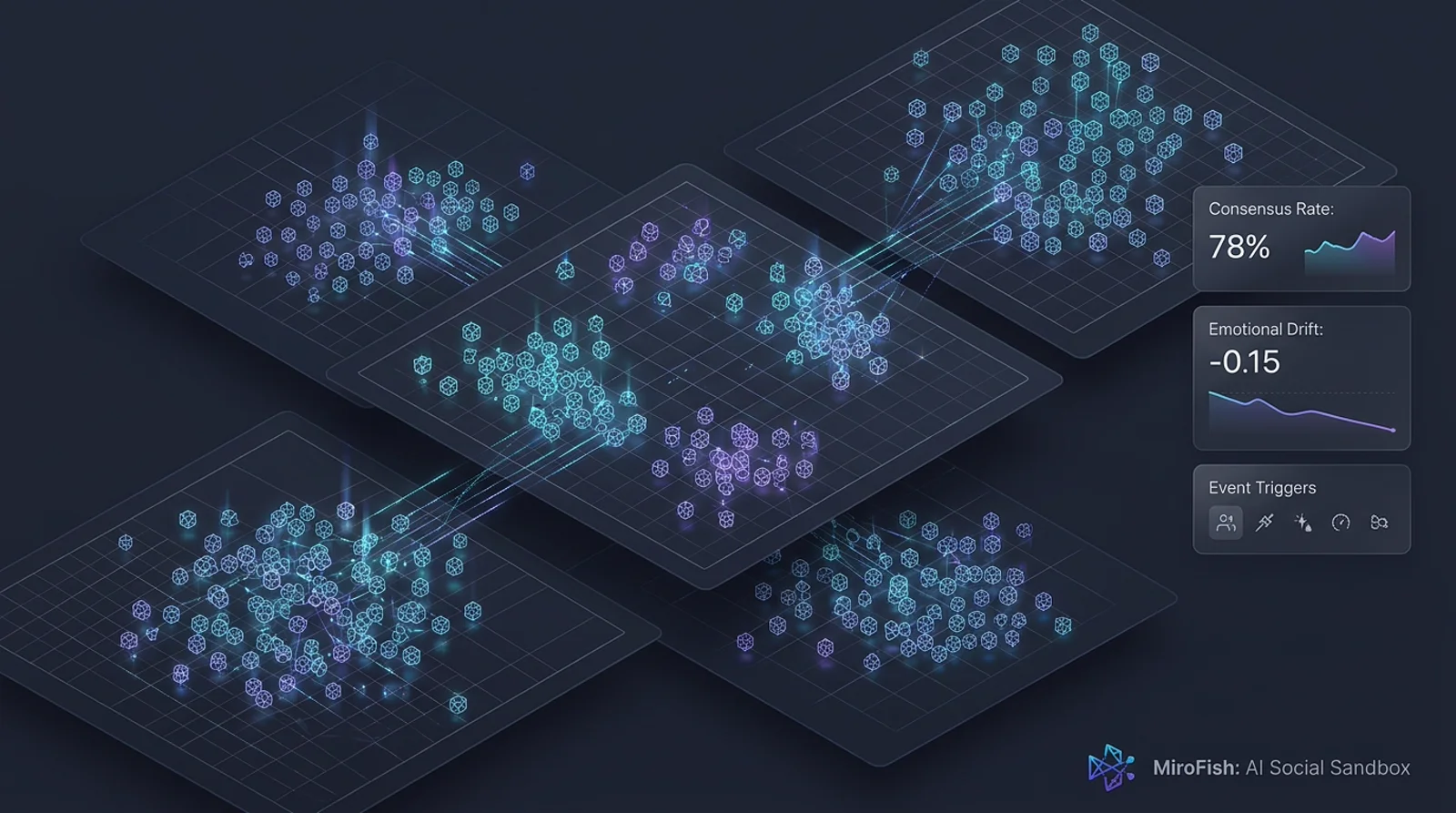
MiroFish: Rehearsing the Future in an AI Social Sandbox
Predicting the future has always been a game of statistics - until now. MiroFish introduces a paradigm shift by moving from “predictive modeling” to “social simulation.”
Part 1: Foundations (The Mental Model)
To understand MiroFish, you must stop thinking of AI as a calculator and start thinking of it as a Digital Sandbox.
In the real world, events aren’t just data points; they are the result of thousands of individual interactions. MiroFish acts as a Swarm Intelligence Mirror. It takes seed information (like a news report or a policy draft) and creates a “Mirror World” populated by intelligent agents.
The mental model is simple: Don’t just calculate the outcome; simulate the players.
Part 2: The Investigation
MiroFish isn’t just a single model; it’s a sophisticated engine that bridges the gap between raw information and social evolution. It stands on two primary pillars:
- High-Fidelity Parallel Worlds: By extracting entities and relationships from seed materials, it builds a specialized GraphRAG (powered by Zep) that serves as the collective memory of the simulation.
- Autonomous Social Interaction: Using the OASIS (Open Agent Social Interaction Simulations) engine, MiroFish populates its digital sandbox with thousands of agents, each with independent personalities, long-term memory, and behavioral logic.
These agents don’t just exist; they interact, form opinions, and undergo social evolution in real-time.
Part 3: The Diagnosis
For developers and decision-makers, MiroFish solves the “What If” problem by providing a God’s-eye view of potential futures.
Deep Dive: How it works for Python Developers
The backend is built with Python, leveraging modern tools like uv for lightning-fast dependency management. The workflow is automated:
- Graph Building: Extracts seed info and injects collective memory into a GraphRAG.
- Environment Setup: Generates personas and agent configurations based on the seed data.
- Simulation: Runs dual-platform parallel simulations (e.g., mimicking Twitter or Reddit interactions) using the OASIS engine.
- Report Generation: A dedicated
ReportAgentanalyzes the simulation’s results to provide a detailed prediction report.
Real Use-Cases
- Public Opinion Simulation: “How will the public react to this new policy?”
- Creative Sandbox: “What would happen if the characters in ‘Dream of the Red Chamber’ made different choices?”
- Financial/Political Signals: Testing the ripple effects of macro-economic signals in a controlled environment.
# A glimpse into how MiroFish manages simulations (simplified)
class SimulationRunner:
    def start_simulation(self, simulation_id: str, platform: str = "parallel"):
        # Initializes the OASIS engine and starts the social sandbox
        process = subprocess.Popen(
            [sys.executable, "run_parallel_simulation.py", "--config", config_path],
            cwd=sim_dir,
            env=env
        )
        # Monitor real-time agent actions...
Part 4: The Resolution
Getting started with MiroFish is straightforward, provided you have the right keys (OpenAI-compatible API and Zep).
- Clone the Repo:
git clone https://github.com/666ghj/MiroFish. - Setup Environment: Configure your
.envwithLLM_API_KEYandZEP_API_KEY. - One-Click Install: Run
npm run setup:allto install frontend and backend dependencies. - Launch the World: Use
npm run devto start both services and access the dashboard atlocalhost:3000.
Final Mental Model
MiroFish = Seed Materials + Multi-Agent Personas + Social Evolution.
It is a rehearsal laboratory where policies, public relations, and creative ideas can be tested at zero risk. By letting every “what if” see its outcome in a digital mirror, MiroFish makes it possible to predict anything by simply watching it happen.
Related posts
- AI & Agents
OpenHuman Explained: The 40k-Star Local AI Superintelligence & Obsidian Memory Engine
Explore OpenHuman, the 40k-star open-source local AI superintelligence featuring Karpathy Obsidian memory trees, TokenJuice, and multi-agent graphs.
11 min readRead → - AI & Agents
Voice-Pro Explained: Local AI Dubbing & Voice Cloning Studio
Discover Voice-Pro, the open-source local AI dubbing studio combining Whisper, Demucs, F5-TTS, and CosyVoice with uv for zero-subscription voice cloning.
8 min readRead → - AI & Agents
VoiceStudio Explained: The 33k-Star Local AI Voice & Dubbing Engine
Explore VoiceStudio, the 33k-star open-source ElevenLabs alternative with 646 languages, OmniVoice cloning, voice design, and native MCP agent support.
8 min readRead → - AI & Agents
Tencent BrowserSkill Explained: How AI Uses Your Logged-In Browser
Tencent BrowserSkill lets AI agents use your logged-in Chrome without stealing focus. Explore tab borrowing, captcha handling, and local daemon architecture.
7 min readRead →