Lemo-Opuscar Explained: 99 Film Styles for Claude Code in Pure Code
Deep dive into Lemo-Opuscar: 99 code-driven film styles for Claude Code using Canvas, WebGL2, Kokoro TTS, Whisper ASR checks, and FFmpeg -14 LUFS muxing.

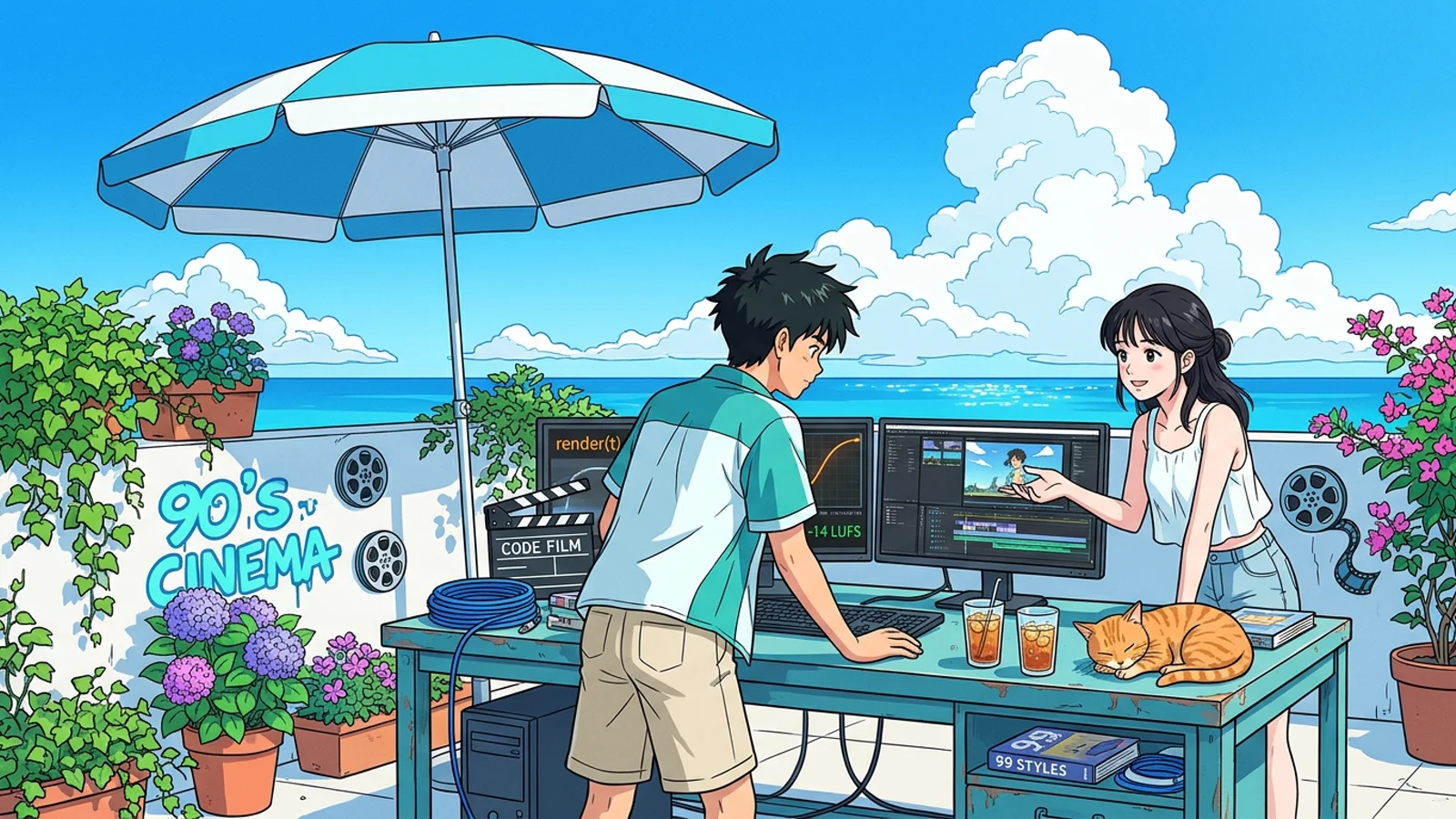
Ask a coding agent to build an animated explainer from scratch in bare HTML5 Canvas or React, and watch your hopes die on frame one. Even when the code compiles cleanly, the output looks like an awkward 2008 PowerPoint slide deck: stiff linear slides, deafening bass synth, captions flashing away before a human finishes the third word, and zero cohesive color grammar.
On the opposite side, generative diffusion video models like Sora, Kling, or Runway paint gorgeous textures, right up until you need to fix one misspelled product label or tweak a chart number. Re-rolling a single caption burns dollars in GPU (graphics processing unit) compute and randomly mutates the entire camera angle.
lemomo-ai/lemo-opuscar bridges that exact craft gap. Instead of inventing a new cloud video model or forcing you to write film-school instructions from zero, it hands Claude Code 99 battle-tested STYLE.md directing bibles paired with a deterministic rendering, audio DSP (digital signal processing), and broadcast mastering pipeline.
TL;DR
Fast Breakdown:
- What is Lemo-Opuscar? An open-source film production toolbox and Claude Code plugin containing 99 programmatic film styles across 15 categories, where the agent directs, writes deterministic Canvas/Three.js code, synthesizes audio, verifies speech with Whisper, and masters MP4 video via FFmpeg.
- Core Breakthrough: Replaces brittle prompt luck with strict cinematography specs (
STYLE.md), reading-speed checks (readcheck.mjs), word-level ASR (automatic speech recognition) verification (asr_check.py), and two-pass-14 LUFSaudio mastering (mux.sh).- Key Trade-Off: Producing one 30 to 60-second film burns 30 to 60 minutes of agent time at
/effort highand demands Node 20+, Python 3.11+, and FFmpeg 7+.- Repository: lemomo-ai/lemo-opuscar on GitHub · MIT (Code) / CC BY-NC 4.0 (Docs) · 20,600+ Stars.
Visual Architecture (Mental Model)
Handing an LLM a blank HTML file for video production is like telling a solo developer to build an indie cinema studio out of raw lumber before filming scene one. Lemo-Opuscar hands the agent a pre-rigged soundstage: 99 physical lighting blueprints on the wall, a cue-locked foley workshop, an automated speech prompter that catches mumbled lines, and a ruthless mastering engineer guarding the exit door.

The Problem: Why Blank-Canvas AI Video Looks Like Slides
Developers already proved agents can render frames with code via frameworks like Remotion or HeyGen’s HyperFrames. Yet most first-time programmatic videos still look amateurish because rendering pixels deterministically is only 20% of filmmaking. The remaining 80% lives in pacing, camera grammar, sound foley, and typography hold times.
Lemo-Opuscar solves this by codifying taste into 99 dense STYLE.md engineering blueprints spanning 15 visual categories: from Watercolor Brush and Blueprint to LiDAR Survey, 80s Cel Anime, and CRT ASCII Terminal. Open styles/cel-anime-80s/STYLE.md and you will not find vague adjectives like “make it nostalgic.” You read hard implementation constraints: paint static backgrounds once at load with paired emissive glow plates, step character cels on twos (12 fps) and lip flaps on threes (8 fps) while keeping camera pans smooth at 24 fps, use colored ink outlines instead of pure black, and never draw gradients inside a cel shape.
Even more striking is DIRECTOR.md, the agent’s mandatory production playbook. Before writing a single canvas draw call, the agent must draft TREATMENT.md with three candidate story structures, a second-by-second beat sheet, a music cue map, and a foley table, explicitly before peeking at the reference DEMO.md source code so it never clones the demo’s plot.
This combination of pure code precision and pre-baked aesthetic taste explains why the repository exploded past 20,600 GitHub stars in two months across the Fable 5.2 and Opus 5.5 ecosystem:

Under the Hood: Single-Timeline Engine and Self-Checking Audio
Strip away the 99 style folders and Lemo-Opuscar’s core engine in core/ is clean, opinionated, and refreshingly hackable. Instead of forcing React bundlers or heavy GUI timelines, every film lives in a self-contained folder with an index.html exposing five JavaScript globals:
window.DUR = 54.2;                    // Total duration in seconds
window.READY = true;                  // Flipped once fonts and assets load
window.EV = [{ t: 1.5, type: "click" }]; // Audio foley trigger timeline
window.TEXTS = (t) => [{ id: "h1", text: "Hello", x0: 80, y0: 90, x1: 420, y1: 150 }];
window.render = (t) => { /* Deterministic draw at second t (no Math.random/Date.now) */ };
Every subsystem reads from that exact contract:
- Multi-Worker Chromium Capture (
core/render/video.mjs): Rather than burning time encoding uncompressed PNGs,video.mjsspawns up to 6 headless Chromium workers (playwright-core), callswindow.render(f / FPS)on each slice, pipesquality: 95JPEG screenshots directly intoffmpeg(libx264,-crf 14), and concatenates segments losslessly via-f concat -c copy. Film grain is explicitly banned inside Canvas because frame-by-frame random noise wrecks encoder bitrate;mux.shapplies deterministic grain during final encoding instead. - Automated Reading-Speed Gate (
core/render/readcheck.mjs): Agents love flashing text cards for 0.8 seconds.readcheck.mjssteps acrosswindow.DURqueryingwindow.TEXTS(t)and fails with exit code1if any title disappears faster than(cjk / 4.5) + (latin / 15) + 1.5seconds or clips outside viewport boundaries. - Self-Verifying TTS & DSP Music (
core/tts/asr_check.py,core/audio/): For narration, Lemo-Opuscar runs Kokoro ONNX offline for English (af_bella,am_michael) or Microsoftedge-ttsonline for Chinese. Thenasr_check.pypads 0.6 seconds of silence around every.wav, runsfaster-whisper, and fails if even one word drifts. In the80s Cel Animedemo (City Lights, 1987), Whisper kept mishearing"Launch is at dawn", forcing the author to rewrite the script line to"The launch is at dawn"untilasr_check.pyexited0. Meanwhile,sampler.pyrenders orchestral scores from CC0/CC-BY libraries (VSCO 2 CE, Salamander Grand Piano),pluck.pysynthesizes folk strings via Numba-accelerated Karplus-Strong (physical string vibration synthesis), andsfx.pybuilds 48 kHz procedural foley mapped directly towindow.EV. - Broadcast Mastering (
core/render/mux.sh): Runs a two-pass EBU R128loudnormfilter targeting-14 LUFS(integrated broadcast loudness standard) followed by a 4x oversampled 192 kHz true-peak limiter at-1.6 dBFS. If lossy AAC encoding introduces inter-sample peaks above-1.0 dBTP,mux.shlowers the limiter ceiling and re-encodes audio up to three times automatically.
Install the plugin directly in Claude Code or clone the toolkit in three lines:
# Install via Claude Code plugin marketplace
claude plugin marketplace add lemomo-ai/lemo-opuscar
claude plugin install lemo-opuscar@lemolab

# Inspect style dependencies & initialize local runtime (~350 MB core tier)
sh ~/.claude/plugins/cache/*/lemo-opuscar/scripts/setup.sh deps
The Rough Edges: Traps Behind the 20K-Star Showcase
Watch the polished showcase films on GitHub Pages and Lemo-Opuscar feels effortless. Open the terminal and read the issue tracker, and four operational traps emerge immediately:
1. The Ubuntu 24.04 ffmpeg 6.1 Hard Rejection
If you run default Ubuntu 24.04 apt packages, setup.sh and mux.sh refuse to run. TECHNIQUE.md and mux.sh line 34 hard-check for FFmpeg 7+ because 6.x misreports audio duration through loudnorm, causing the strict truncation check to reject valid mixes. You must drop a static FFmpeg 7 or 8 binary onto your PATH before rendering.
2. The LEMO_COLOR=bt709 Washed-Out White Bug (Issue #62)
Setting LEMO_COLOR=bt709 to standardize television color tags exposes a real pipeline mismatch documented in GitHub Issue #62. video.mjs encodes JPEG screenshots with -pix_fmt yuv420p, producing limited-range (16-235) frames without a color_range tag. Yet mux.sh’s bt709 branch assumes full-range input (scale=in_range=pc:out_range=tv), squeezing whites a second time from 251 down to muddy grey 229. Leave LEMO_COLOR unset for web playback, or re-expand range beforehand:
# Pre-expand video.mjs output before running LEMO_COLOR=bt709 (Issue #62 workaround)
ffmpeg -v error -y -i out/video.mp4 -vf "scale=in_range=tv:out_range=pc,format=yuvj420p" -c:v libx264 -crf 10 out/video_pc.mp4
LEMO_COLOR=bt709 sh core/render/mux.sh out/video_pc.mp4 out/mix.wav out/final.mp4 24 0
3. Heavy Token Burn, Time Cost, and Image-Gen Dependencies
Generating one finished short is not instant. Lemomo’s own README warns plainly: one film burns 30 to 60 minutes of wall-clock time and substantial tokens with Claude Fable 5.2 or Opus 5.5 at /effort high. Running lesser models breaks complex multi-layer canvas geometry or loses STYLE.md consistency. Furthermore, three styles marked with a star (✦: Text Flash Cuts, Comic History Cartoon, Manga Panels) refuse to start unless you supply an external image generator (codex exec or your own API via core/image/gen_image.py).
4. The 4-Tier Hybrid License (MIT vs CC BY-NC 4.0)
Following third-party commercial repackaging of v1 prompts, Lemomo moved v2.0.0 onto a nuanced 4-tier LICENSE:
- Engine & Demo Code: Pure MIT.
- Guides &
STYLE.mdPrompts: CC BY-NC 4.0, plus an explicit Additional Permission granting creators and client teams commercial rights to produce and monetize their own films (confirmed in Issue #67). Selling the prompt library or embeddingSTYLE.mddocs inside a paid SaaS product requires a commercial license from SecondFirst Pty Ltd (LemoLab). - Exclusions: Anthropic’s orange mascot (
ClawdinMascot ScreencastandOPUSCAR 98) and six online TTS narration tracks (Edge TTS / Doubao TTS) are explicitly excluded from reuse.
Decision Matrix: Lemo-Opuscar vs HyperFrames vs Remotion
Code-driven video is no longer a one-horse race. Choose your tool based on how much creative direction versus reusable template infrastructure your project needs:
| Dimension | Lemo-Opuscar | HeyGen HyperFrames | Remotion |
|---|---|---|---|
| Primary Interface | 99 STYLE.md bibles + DIRECTOR.md skill |
Plain HTML/CSS + data-start clips |
React JSX components + Vite/Webpack |
| Audio & Foley Pipeline | Built-in Kokoro TTS, Whisper ASR, DSP & -14 LUFS mux |
Manual audio placement + FFmpeg | @remotion/media-utils / external |
| Target Operator | Claude Code (Fable 5.2 / Opus 5.5 /effort high) |
Any coding agent or web developer | Frontend engineering teams |
| First-Render Speed | Slow (30-60 min agent session) | Fast (1-5 min HTML synthesis) | Fast once templates exist |
| Sweet Spot | Bespoke narrative shorts & stylized explainers | Clean UI product demos & PR videos | High-volume parameterized SaaS batches |
Adopt Lemo-Opuscar if: You want Claude Code to direct cohesive stylized short films with synchronized music, foley, and broadcast loudness without assembling a media stack yourself.
Skip Lemo-Opuscar if: You need instant 18-variant SaaS ad batches driven by JSON manifests (use Remotion), lightweight HTML/GSAP UI walkthroughs on budget tokens (use HyperFrames), or realistic human talking-head footage.
Final Take
Lemo-Opuscar proves that the secret to agentic filmmaking was never waiting for a smarter video diffusion model. It is forcing the coding agent to obey strict cinematography constraints, deterministic clocks, reading-speed gates, and broadcast audio checks before a single frame hits disk. Strip out the romanticism around “AI cinema” and what remains is disciplined systems engineering applied to storytelling.
Hands-On Challenge (15-Minute Test)
Test Lemo-Opuscar’s core deterministic verification loop locally without spending a single LLM token:
- Check your host binaries: verify
node -v(>=20),python3 --version(>=3.11), andffmpeg -version(>=7.0). - Clone the repo using sparse checkout (
sh plugin/skills/lemo-opuscar/scripts/setup.sh) so you avoid downloading 200 MB of gallery assets, then install the core dependencies (... setup.sh deps). - Create a minimal folder
test-clip/index.htmldefiningwindow.DUR = 4,window.READY = true,window.render = (t) => ...drawing a moving progress bar on<canvas>, andwindow.TEXTS = (t) => ...returning a headline bounding box that disappears att = 1.0s. - Run
node core/render/readcheck.mjs test-clipand watch it catch your unreadable headline with exit code1, then bump the hold time past3.0suntil bothreadcheck.mjsandnode core/render/video.mjs test-clip --fps 24pass cleanly.
Frequently Asked Questions (FAQ)
1. Can I monetize YouTube or TikTok videos made with Lemo-Opuscar under CC BY-NC 4.0?
Yes. In LICENSE and GitHub Issue #67, LemoLab explicitly confirms that films you produce with the style library belong to you, including monetized creator channels and paid client deliverables, with zero required watermark or credit. The CC BY-NC 4.0 restriction targets commercial redistribution, reselling the STYLE.md prompt packs, or wrapping the docs into a commercial SaaS product.
2. Does Lemo-Opuscar require an expensive GPU or paid video API keys?
No for 96 of the 99 styles. Most scenes render 2D Canvas or WebGL2 through headless Chromium on CPU (or integrated laptop GPUs), use offline Kokoro ONNX voices, synthesize foley in NumPy/SciPy, and download free CC0/CC-BY instrument libraries. Only the three styles marked ✦ require an external image generator (codex exec or your own tool), and Chinese online voices use Microsoft edge-tts.
3. Why does Lemo-Opuscar insist on Claude Fable 5.2 or Opus 5.5 instead of smaller models?
Each STYLE.md combines multi-layer canvas compositing, seeded world-to-screen transforms, strict reading-speed invariants, and synchronized score cue tables across thousands of lines of code. Smaller or low-effort models frequently break deterministic frame math (Date.now() leaks), misalign lip-sync tracks, or fall back into generic flat slides.
4. Can I customize a style without overwriting upstream library updates?
Yes. Follow MY-STYLES.md to create modified or blank-page styles saved inside ~/lemo-my-styles/<slug>/. Library updates and claude plugin update commands leave ~/lemo-my-styles/ untouched and remind you once when an upstream base STYLE.md improves.
Related posts
- AI & Agents
HyperFrames Explained: Write HTML. Render Video. Built for Agents
How HeyGen's HyperFrames turns standard HTML, CSS, and seekable animations into deterministic MP4 videos, giving AI coding agents full programmatic video control.
12 min readRead → - Developer Tools
Programmable Motion Design: Automated Video Engine with Remotion
Turn 18 open-source animation repos into a deterministic video engine. Build reusable Remotion components, Canvas seek(t), and export 18 campaign variants.
10 min readRead → - AI & Agents
OpenMontage: Your Coding Agent Becomes the Video Director
Open-source agentic video production: 12 pipelines, 52 Python tools, 400+ skills. Claude or Cursor orchestrates research, assets, edit, and render.
7 min readRead → - Developer Tools
MarkdyScript: The Mermaid of Motion
MarkdyScript is a declarative text DSL that turns 30 lines of plain code into Web Animations API scenes, git-diffable, LLM-friendly, and zero GSAP.
9 min readRead →