App Store Compliance Explained: Stop Rejections Before You Submit
Deep dive into mjmirza/app-store-compliance: 124 rejection rules, PreToolUse submit hooks, 114 legal deadlines, and .app-review-readiness.json audits.

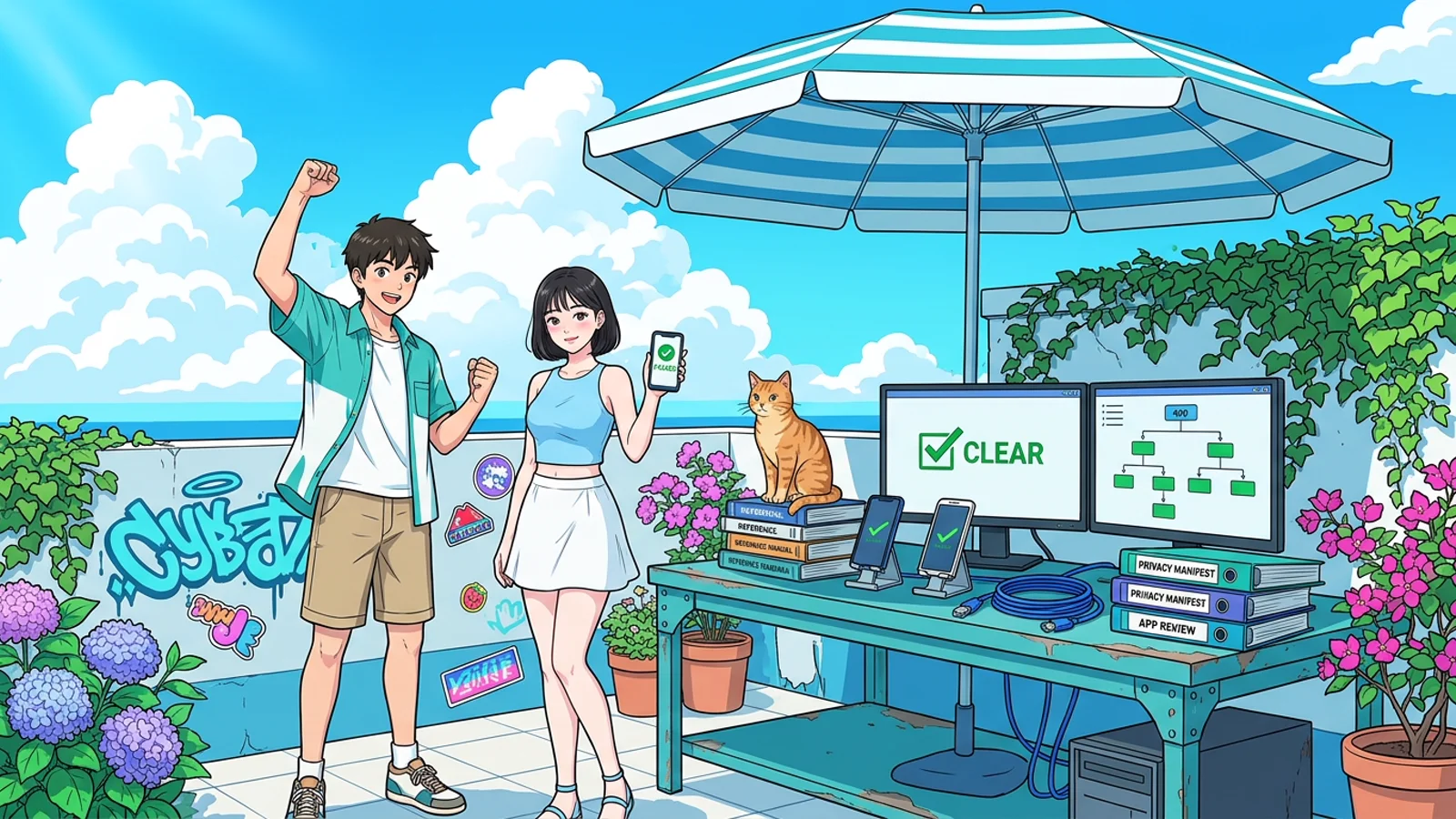
Build a mobile app with Claude Code or Cursor over a weekend, and Tuesday night feels effortless. Screens compile cleanly in the iOS Simulator (Apple’s local device emulator), so you tell your agent to run fastlane deliver (an automated store upload CLI).
Five days later, App Review kills the release with a one-line rejection email. You forgot PrivacyInfo.xcprivacy (Apple’s mandatory Privacy Manifest listing data types and API reasons), shipped a staging API URL inside Release, or named a custom pre-permission button Allow instead of Continue. That single miss burns an entire week.
mjmirza/app-store-compliance, created by Mirza Iqbal (v2.5.1, 6,200+ stars), turns App Review rules into a mechanical kill switch inside your terminal. It installs a read-only Bash scanner across 12 AI coding tools so your agent refuses to push any build while critical rejection risks remain.
TL;DR
Fast Breakdown:
- What is App Store Compliance Playbook? An open-source compliance playbook, read-only Bash guard (
app-store-compliance-guard.sh), and coding agent skill covering124Apple App Store and Google Play rejection patterns (62Apple,43Play,13Both,6Web),113detection recipes, and114dated legal deadlines (EU AI Act,COPPA, state age laws).- Core Breakthrough: Intercepts
PreToolUseshell commands across 12 AI tools (including wrappednpm runandMakefilescripts), splits readiness into code-scannable checks versus owner-attested runtime items (.app-review-readiness.json), and exits2(BLOCKED.) on release blockers.- Key Trade-Off: Heuristic
greprules can trigger false positives on lockfiles (our live scan on this web repo flaggedpnpm-lock.yaml), static checks cannot catch subjective Guideline4.3spam duplication, and the project usesOpenRoots Agent License 2.3instead of MIT.- Repository: mjmirza/app-store-compliance on GitHub · OpenRoots ORA 2.3 · 6,200+ Stars.
Visual Architecture (Mental Model)
Treating store review as a formality is like driving a custom car onto a runway without checking tire pressure or flight clearance. app-store-compliance bolts a mechanical interlock onto your ignition: your agent cannot pull the fastlane, eas submit, or gradlew bundleRelease lever until both your source artifacts and your signed readiness ledger clear inspection.

The Problem: Why AI-Built Apps Die in App Review
AI coding tools made mobile apps fast to generate, not easy to pass review. According to the 2026 metrics cited in the repository, iOS releases jumped roughly 80% year over year in Q1 2026, yet Apple rejected around 1.93 million of 7.77 million submissions (nearly one in four), and Google blocked over 1.75 million Play submissions in 2025.
Agents fail because LLMs optimize for local simulator builds, not human reviewers on live networks. Your agent builds a smooth onboarding modal with an Allow button before the location dialog, forgetting Apple HIG forbids it (APPLE-5.1.1-PRE-PROMPT-ALLOW-BUTTON). It installs Firebase without writing PrivacyInfo.xcprivacy, omits in-app account deletion (5.1.1(v)), or ships Play Billing Library below 8.x.
Resubmitting blindly on Google Play compounds policy strikes toward permanent account suspension. Developers kept hitting this wall before the repo went viral on X:


Under the Hood: Submit Hook Interception and the Two-Halves Architecture
Inside the 2,184-line Bash guard (agent-os/hooks/app-store-compliance-guard.sh) and its Python helpers, every design choice aims to eliminate false safety and daily terminal friction.
1. Multi-Agent PreToolUse Interception
Running scripts/install.sh --tool all installs the guard, skill files, and /app-store-audit command across 12 AI coding tools (Claude Code, Codex CLI, Gemini CLI, OpenCode, Cursor, GitHub Copilot, Grok, Qwen Code, Kimi Code, Factory Droid, Augment Auggie, and Windsurf), backs up configs, and feeds a mock submit JSON payload through doctor to confirm the hook actually blocks uploads.
Three mechanics keep the hook practical in daily coding:
- Inert Prose Masking (
INERT_AWK): Runninggit commit -m "fix fastlane deliver"does not upload anything.INERT_AWKblanks quoted commit messages, PR descriptions,echostrings, and non-executable heredocs before matching submit triggers. - One-Level Runner Unwrapping (
runner_body): Agents hide uploads insidenpm run release:iosormake ship. The guard peeks insidepackage.jsonscripts andMakefiletargets one level deep to catch wrappedfastlane,eas submit,xcrun altool,flutter build ipa, andgradlew bundleReleasecommands. - Android-Only Target Awareness: Cross-platform repos always carry an
ios/folder. When a hook command explicitly builds Android only (likeflutter build appbundle), Apple checks stay silent unless another chained segment touches iOS.
# Scan standalone without installing hooks or modifying files
git clone https://github.com/mjmirza/app-store-compliance ~/repositories/app-store-compliance
bash ~/repositories/app-store-compliance/agent-os/hooks/app-store-compliance-guard.sh "/path/to/your/app"

# Preview hook and skill wiring across all detected AI tools
bash ~/repositories/app-store-compliance/scripts/install.sh --tool all --dry-run
2. Cross-Platform Scanning & Two-Halves Honesty
Beyond native Swift/Kotlin, the guard inspects Flutter, React Native / Expo (reading app.json and app.config.* even before npx expo prebuild), Ionic / Capacitor / Cordova (UIWebView checks for ITMS-90809), Unity, .NET MAUI, Tauri mobile, and Kotlin Multiplatform. It isolates nested monorepo apps (app_roots) and strips #if DEBUG Swift blocks before flagging localhost or staging endpoints (APPLE-2.1-STAGING-BACKEND).
After ~300 X replies challenged static scan blind spots in November 2026 (docs/WHAT-THE-SCAN-PROVES.md), v2.5.0 introduced a strict Two-Halves contract. Code checks run alongside .app-review-readiness.json, an owner-attested ledger covering demo_account, live_backend, review_notes, screenshots_match_build, account_deletion_device_test, privacy_labels_match_runtime (n/a banned), and iap_reachable_by_reviewer. Its Python parser uses O_NONBLOCK, a 10-second SIGALRM timeout, an 8 MiB cap, and keep_dups so duplicate keys or stalled FIFOs cannot smuggle a "fail" through.


3. Soft-404 Citation Proofing, Deadlines & Listing Audits
To stop stale rules from creating false confidence, four verification tools anchor the rule pack:
- Anti-Soft-404 Verifier (
scripts/verify-citations.py): Apple Developer News returns HTTP200for nonexistent IDs (?id=zzzz-control-not-a-real-id-zzzz). The verifier hashes a bogus control page per host and fails any citation matching that fingerprint. - 60-Day Staleness Check (
Rule pack.): Every scan prints its verification window (2026-07-13to2026-11-23inv2.5.1) and warnsRule pack STALE.once the newest source crosses 60 days. - Rolling 90-Day Deadlines (
scripts/deadline-checker.py): Prints imminent mandates per platform, including Google Play Japan payments auth (2026-12-01), EU AI Act updates (2026-12-02), CaliforniaAB 1043(2027-01-01), Apple age ratingShared LocationandDatingdescriptors (2027-01-12), Apple China mainland AI filings (2027-01-31), and Play EEA/UK trader status (2027-02-01). - Store Listing Audit (
scripts/metadata-audit.py): Audits locale folders for overflows, placeholders, missing subscription Terms/EULA links, and ranking claims (#1,best app). Runningscripts/validate.pyandscripts/eval-scorecard.pylocally verified124patterns,113recipes,114deadlines (0errors), and32/32gold cases (100.0%accuracy,0false passes).
The Rough Edges: False Positives, Blind Spots, and License Rules
Running and inspecting the scripts exposes four practical boundaries you must account for before trusting CLEAR.:
1. Lockfile Noise & Regex Heuristics
When we ran app-store-compliance-guard.sh directly against this Astro repository, it finished in 3 seconds, detected Web=1, and flagged [HIGH] WEB-TRACKING-TECHNOLOGIES at pnpm-lock.yaml:3068 because scan_tree indexes all *.yaml files. Similarly, mobile heuristics like IONIC-4.2-THIN-WRAPPER or APPLE-ACCESSIBILITY-HAPTICS serve as review nudges rather than hard verdicts; verified exceptions require APP_STORE_GUARD_OK=1 or Fleet Sweep waivers.
2. The Unscannable Half: Guideline 4.3, Podfile, and GUI Uploads
Terminal hooks never catch Distribute App clicks in Xcode Organizer, Android Studio GUI exports, or CI runners unless wired into Fastlane before_all or CI YAML. No local script can evaluate subjective Apple Guideline 4.3 niche saturation against live App Store rivals, inspect native SDKs declared exclusively in a Podfile, or verify localized InfoPlist.strings keys reached Info.plist.
3. Hook Timeout Pressure and python3
Large monorepos approach Claude Code’s 60-second hook timeout (APP_STORE_GUARD_SLOW_SECS=45 warns you to set timeout to 120 in settings.json). While Claude Code’s basic Bash hook runs standalone, all 11 other tools (install_harness.py), .app-review-readiness.json parsing, and PrivacyInfo.xcprivacy validation depend on python3.
4. OpenRoots Agent License 2.3 (Not MIT)
Since August 27, 2026, the repo switched from MIT/CC-BY to OpenRoots Agent License 2.3 (LicenseRef-OpenRoots-ORA-2.3). Individuals, nonprofits, schools, governments, and companies at or below $20 million annual gross revenue use it free of royalties. Above $20M, attributable revenue owes 0.5% (capped at $250,000/yr), commercial reselling of the playbook requires a separate agreement, and AI model training is excluded at all tiers without a Compute license.
Decision Matrix: Guard Hook vs Fastlane Precheck vs Manual Checklists
| Dimension | app-store-compliance (v2.5.1) |
fastlane precheck |
Manual PDF Checklists |
|---|---|---|---|
| Enforcement | Blocks agent CLI submits (exit 2) pre-upload |
Checks metadata inside Fastlane lane | Relies on human discipline |
| Coverage | 124 code/SDK patterns + 114 legal deadlines + metadata | Store listing text & URLs only | Broad guidance, zero automation |
| Honesty | Separates code scan from .app-review-readiness.json |
Silent on binary & manifest bugs | High false confidence |
| Best Fit | Devs shipping iOS/Android/Expo via AI agents | Existing CI lanes checking ASC text | Final non-technical founder audit |
Adopt app-store-compliance if: You build iOS, Android, Flutter, or Expo apps with AI agents and want an automated gate catching missing privacy manifests, staging URLs, and 2026 regulatory cutoffs before upload.
Skip if: You ship exclusively via Xcode Organizer GUI without CI hooks, or your legal department blocks OpenRoots ORA 2.3 dependencies.
Final Take
AI coding tools erased the cost of generating mobile screens, shifting the bottleneck squarely onto App Review discipline. mjmirza/app-store-compliance earns its spot in your stack because it refuses fake certainty: it blocks obvious binary disasters in seconds, forces you to attest to the live runtime checks a script cannot prove, and stops a missing manifest from wasting another week in queue.
Hands-On Challenge (15-Minute Test)
Verify the rule database, run the evaluation scorecard, and test-scan an app without modifying your IDE configuration:
git clone --depth 1 https://github.com/mjmirza/app-store-compliance ~/repositories/app-store-compliance
cd ~/repositories/app-store-compliance

python3 scripts/validate.py && python3 scripts/eval-scorecard.py
python3 scripts/deadline-checker.py --brief
bash agent-os/hooks/app-store-compliance-guard.sh "/path/to/your/app"
bash scripts/install.sh --tool all --dry-run
Frequently Asked Questions (FAQ)
1. Does a CLEAR. exit code guarantee Apple or Google Play approval?
No. CLEAR. confirms zero critical code, manifest, or build configuration blockers were found in your files. Human reviewers still test live backends, demo accounts, screenshots, and Guideline 4.3 app uniqueness, which is why v2.5.0+ pairs the scan with .app-review-readiness.json.
2. Is app-store-compliance-guard.sh safe on private commercial codebases?
Yes, by inspection. The guard is a transparent 2,184-line Bash script that opens project files read-only, cleans up temporary buffers on exit, makes zero network calls while scanning, and leaves every source file untouched.
3. Does it support Android and Google Play, or only Apple iOS?
It covers both deeply. Of 124 documented patterns, 62 target Apple, 43 target Google Play, 13 cover both stores, and 6 cover web rules, checking target API 36+, Play Billing 8.x, 64-bit ABIs (Application Binary Interfaces), R8 minification, and Data Safety SDK triggers.
4. Can indie developers and startups use it commercially under OpenRoots ORA 2.3?
Yes. Under OpenRoots Agent License 2.3, individuals, nonprofits, schools, governments, and companies generating $20 million or less in annual gross revenue get royalty-free commercial use, provided they do not resell the playbook standalone or train AI models on it without a Compute license.
Related posts
- AI & Agents
mattpocock/skills Guide: Cure Vibe Coding With /grill-me & Deep Modules
Install mattpocock/skills (npx skills add mattpocock/skills) to enforce /grill-me specs, deep modules, and clean refactoring in Claude Code and Cursor.
11 min readRead → - AI & Agents
Cloudflare Security Audit Skill: The Adversarial AI Vulnerability Harness
Deep dive into Cloudflare's security-audit-skill: how isolated multi-agent harnesses eliminate LLM hallucination and automate fleet-wide vulnerability discovery.
8 min readRead → - AI & Agents
Vercel Skills Explained: The Open Agent Package Manager
How Vercel's npx skills creates a universal package manager for 79+ AI agents: architecture, symlink pipelines, skills-lock determinism, and security edges.
11 min readRead → - AI & Agents
Android Reverse Engineering Skill: Unpacking APKs Like a Pro
A Claude Code skill that decompiles Android apps and extracts their hidden APIs - no source code required. For security pros, hackers, and the curious.
5 min readRead →